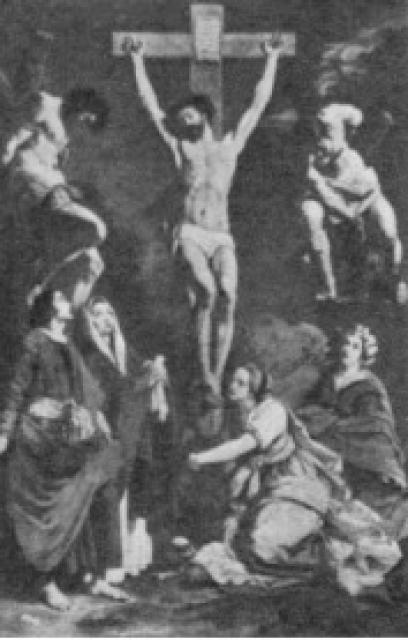
Abraham Yansens
 Belgium
Biography of Abraham Janssens
Abraham Janssens was a Belgian artist who lived in the early 17th century. During this time, painting in Flanders experienced a period of great prosperity. The number of artists and workshops increased, as did the circle of patrons. The main patrons were the churches, which needed large altar paintings that would not only captivate viewers with their subject matter, but also emotionally engage them. These paintings also had to conform to the opulence of the baroque style that was prevalent in Europe at the time. Another patron was the nobility, who preferred to decorate their castles and palaces with huge tapestry-like paintings depicting scenes of hunting, forest landscapes, religious, allegorical, and mythological subjects.
Unique Style and Influences
Unlike most artists of his time, who were heavily influenced by Rubens, Janssens had his own unique style in painting. At one point, he even became Rubens' only rival. However, Janssens was not completely free from Rubens' charm. He skillfully combined it with the traditions of the old Netherlandish romanticism and Caravaggism.
Life and Career
Janssens was born, lived, and died in Antwerp. From the 15th century onwards, Antwerp was considered one of the main centers of Flemish art. The famous Guild of Saint Luke, a unique union of painters, was founded and thrived here. Painting was highly esteemed in Antwerp, and throughout Flanders, more than any other form of art. As a result, all artists aspired to come to this city, where the most diverse and sometimes completely opposite directions of painting peacefully coexisted. As a young artist, Janssens studied under J. Snellinck, a faithful follower of Martin de Vos and representative of late Mannerism. In 1598, Janssens traveled to Rome, the European equivalent of Antwerp at the time. The best forces of European art gathered there, and new artistic movements were formed. One of them, known as Caravaggism (named after its founder Caravaggio), became fashionable. After a few years, Caravaggism spread throughout Europe, and few artists were unaffected by its influence. Janssens, a young and searching artist, quickly embraced the artistic principles of Caravaggism, which involved a departure from the abstract principles of academicism and a tendency towards a realistic portrayal of life in all its sometimes harsh manifestations.
Artistic Achievements
Upon his return to Antwerp, Janssens became a master in 1601, which granted him the right to have his own painting workshop. In 1606, he was elected dean of the Guild of Saint Luke. Although Rubens, the true master of Flemish painting, returned from Italy in 1608 and overshadowed Janssens' position, Janssens continued to lead an active artistic career. His studio produced a huge number of paintings in the 1610s-1620s. Janssens' paintings during this period showcased his ability to capture the plastic authenticity of the human body through complex perspectives, various gestures, the interconnection of figures, and spatial shifts. In his later years, Janssens focused more on religious works, particularly altar paintings, which were a traditional genre in the Netherlands. These paintings adhered to all the rules and canons, with figures depicted in almost sculptural solidity and volume. However, there was a sense of theatricality and artificiality in these works, perhaps paying homage to Rubens' genius but lacking his immense vitality.