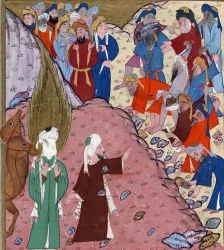
Abu Sufyan ibn Harb
Abu Sufyan ibn Harb was a prominent merchant and political leader of the Quraysh, the tribe that dominated Mecca in the early seventh century. He first led opposition to the emerging Muslim community in Medina, then accepted Islam shortly before the Muslim conquest of Mecca in 630. His life bridged two political orders: the old mercantile leadership of Mecca and the rapidly expanding Muslim polity.
Leader of Quraysh
Known by the personal name Sakhr, Abu Sufyan belonged to the Banu Abd Shams, a powerful Quraysh clan. He oversaw trade and took part in the political decisions through which Meccan leaders sought to contain Muhammad’s movement. In 624, he led the Quraysh caravan whose interception helped set the stage for the Battle of Badr. After the Muslims defeated the Meccan force there, Abu Sufyan became a leading figure in the city’s campaign against Medina.
He is associated with the Quraysh victory at the Battle of Uhud in 625 and with the coalition that besieged Medina during the Battle of the Trench in 627. These events are known mainly through later Muslim historical narratives, which preserve important accounts of early Islam but also reflect the perspectives of their transmitters.
Conversion and later life
As Muslim power grew, Abu Sufyan sought terms with Muhammad. Traditional accounts describe him meeting the Muslim army before it entered Mecca in 630 and accepting Islam shortly before the city’s surrender. The conquest was followed by a general amnesty, and reports say that people who took refuge in Abu Sufyan’s house were also promised safety. His conversion marked the accommodation of a major Meccan leader to the new political and religious order.
Afterward he took part in campaigns alongside the Muslims. Accounts describe him fighting at Hunayn and losing an eye during the campaign at Ta’if; later tradition also associates him with the Syrian conquests. He lived in Medina in his later years and died around 653. His son Mu’awiya would later become caliph and establish the Umayyad dynasty, giving Abu Sufyan’s family a central place in Islamic political history.
Legacy
Abu Sufyan’s career is often told as a dramatic change from opponent to Muslim leader. The surviving narratives differ in how they explain his motives, and later political conflicts shaped his reputation. His historical significance lies in his influence among the Quraysh and in the transition of Meccan elites into the new Islamic community. Through his descendants, his family also became closely tied to the first dynastic caliphate.