Andy Warhol
 United States
- Pittsburgh beginnings
- Pop art and the Factory
- The 1968 shooting and a new direction
- Private life and public image
- Final years and legacy
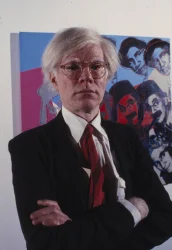
Andy Warhol turned the ordinary and the famous into some of the most recognizable images in modern art. Campbell’s soup cans, Marilyn Monroe, car crashes, and electric chairs all became material for an artist who blurred the boundaries between painting, advertising, film, music, and celebrity. The silver-haired figure behind the work cultivated an aura of cool detachment, but his career was built on relentless curiosity about how images circulate and how fame is made.
Pittsburgh beginnings
Born Andrew Warhola in Pittsburgh, Pennsylvania, in 1928, he was the youngest son of working-class Rusyn immigrants from what is now Slovakia. As a child he was often ill and spent long periods drawing, listening to the radio, and collecting images of movie stars. His mother, Julia, encouraged his art and later joined him in New York. He studied pictorial design at the Carnegie Institute of Technology, graduating in 1949.
Warhol moved to New York soon afterward and shortened his name to Andy Warhol. He built a successful career as a commercial illustrator, producing advertising and editorial work for magazines and retailers. The crisp lines, bold color, and repeatable images of commercial art would remain in his fine art, even as he challenged the assumption that painting had to be unique, handmade, and separate from popular culture.
Pop art and the Factory
By the early 1960s, Warhol had made consumer products and celebrities central subjects. His Campbell’s Soup Cans and portraits of Marilyn Monroe, Elvis Presley, and Elizabeth Taylor used photo-silkscreen techniques that let him repeat an image while altering its colors and surfaces. The mechanical-looking repetitions raised questions about originality and authorship: if a familiar image could be reproduced again and again, what made an artwork distinctive?
His New York studio, known as the Factory, became both a workshop and a social scene. Assistants helped produce artworks, while actors, musicians, writers, and visitors moved through the space. Warhol’s films from this period ranged from static portraits, including the Screen Tests, to longer experimental works such as Sleep and Empire. He also worked with the Velvet Underground, helping bring the band to wider attention and designing the banana image for its 1967 debut album.
The Factory’s glamour came with its own difficult dynamics. Warhol surrounded himself with collaborators and personalities whose performances and public images became part of the art world spectacle. His interest in fame was both subject and strategy: he made himself a recognizable public character while insisting, in interviews, on an enigmatic reserve.
The 1968 shooting and a new direction
On June 3, 1968, writer Valerie Solanas shot Warhol at the Factory and also wounded art critic Mario Amaya. Solanas had appeared in one of Warhol’s films and had become angry over a script she believed he had taken. Warhol was critically injured and underwent a long recovery. The shooting left lasting physical effects and changed the atmosphere of the Factory. Afterward, the studio became more controlled and businesslike, and Warhol became more guarded about access to his personal world.
He continued working across media. In the 1970s he made commissioned portraits, including images of political figures and celebrities, and created series such as Mao and Ladies and Gentlemen. His entrepreneurial reach expanded through publishing, photography, and television. The magazine Interview, which he helped found in 1969, made celebrity conversation and image-making central to its format. In the 1980s he hosted cable programs and collaborated with younger artists, including Jean-Michel Basquiat and Francesco Clemente.
Private life and public image
Warhol’s public persona was deliberately hard to read: he spoke softly, offered clipped answers, and often let the camera record him rather than perform in a conventional way. He was intensely private about parts of his personal life, and accounts of his relationships vary. His diaries, kept by telephone and dictated to an assistant, later revealed a sharp observer of money, status, and the people around him. They also showed the labor behind his carefully maintained public image.
Final years and legacy
Warhol continued producing work until his death in New York on February 22, 1987, following complications after gallbladder surgery. He was 58. His estate helped establish the Andy Warhol Foundation for the Visual Arts, and the Andy Warhol Museum opened in Pittsburgh in 1994, housing a major collection of his work and archives.
Warhol’s influence extends well beyond Pop art. He helped make mass media, branding, celebrity, and repetition serious subjects for art, and he worked as if painting, film, music, publishing, and self-presentation belonged to one continuous practice. The questions his work raised about image and originality have only grown more immediate in a culture saturated with screens and reproductions.