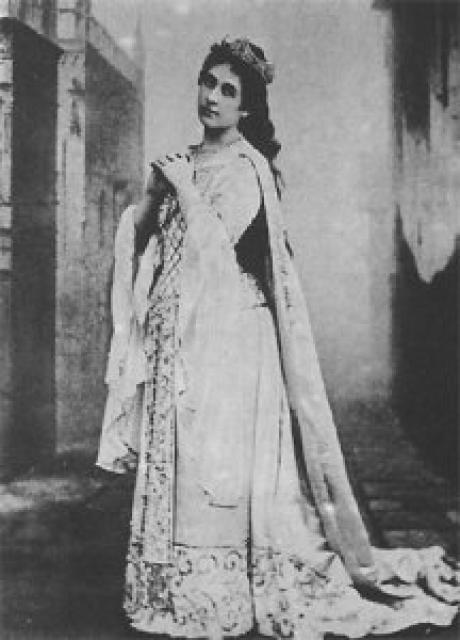
Adelaida Bolska
 Estonia
- Early Life and Education
- Professional Debut and Success
- International Recognition
- Mariinsky Theatre Years
- Later Career and Legacy
- Philanthropic Endeavors
Early Life and Education
Born in Russia, Adelaya Skompska displayed a remarkable talent for singing at a young age. She attended a closed monastic boarding school in Munich, initially studying piano and later voice. In 1883, she enrolled in the Moscow Conservatory, where she honed her skills under the tutelage of Giacomo Galvani and Fyodor Komissarzhevsky.
Professional Debut and Success
Skompska made her professional debut in 1889 at the Bolshoi Theatre in Moscow, performing as Pamina in Mozart's "The Magic Flute." She quickly established herself as a rising star, earning acclaim for her lyrical soprano voice and expressive stage presence. Her repertoire expanded to include iconic roles such as Goryslava in Glinka's "Ruslan and Lyudmila" and Tatyana in Tchaikovsky's "Eugene Onegin."
International Recognition
After leaving the Bolshoi Theatre in 1892, Skompska continued her career in France and Italy. Inspired by the renowned French soprano Miolan-Carvalho, she refined her technique and adopted the stage name "Bolska" at the suggestion of composer Jules Massenet. Performing as Bolska, she captivated audiences in Barcelona, Paris, and London.
Mariinsky Theatre Years
In 1897, Bolska returned to Russia to join the prestigious Mariinsky Theatre in Saint Petersburg. For over two decades, she graced the stage as a leading soprano, premiering several significant roles, including Волхова in Rimsky-Korsakov's "Sadko" and Marfa in his "The Tsar's Bride." She also introduced Russian audiences to Wagner's Зиглинда in "Die Walküre" and Eva in "Die Meistersinger von Nürnberg."
Later Career and Legacy
Bolska's contract with the Mariinsky Theatre was terminated prematurely in 1918, but she continued to perform occasionally in concert programs. She also served as professor of vocal studies at the Petrograd Conservatory and later in Warsaw. Her legacy as an acclaimed opera singer and dedicated teacher endures.
Philanthropic Endeavors
Throughout her career, Bolska dedicated herself to charitable causes. She was a patron of the Roman Catholic Church of St. Catherine in Saint Petersburg and frequently participated in fundraising concerts. Notably, in 1901, she played a pivotal role in securing permission and funds to establish a monument to Frédéric Chopin in Warsaw, which was unveiled in 1926.


