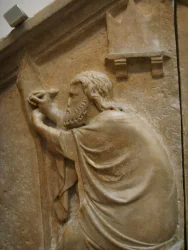
Aelian
Aelian was a Roman who made his name by writing in Greek. A teacher of rhetoric in the third century, he gathered striking stories about animals, philosophers, rulers and customs, preserving details from earlier works that have since disappeared. His writing sits between natural history and moral storytelling: animals are not just curiosities, but characters whose courage, loyalty or cleverness can expose the flaws of human beings.
A Roman voice in Greek
Claudius Aelianus, known simply as Aelian, was born in Praeneste, a town near Rome, probably around 175. The exact dates of his life are uncertain; he is usually placed in the late second and early third centuries. Although Roman by birth, he became known for his command of Greek, especially the polished Attic style admired by teachers of rhetoric. Ancient biographers described him as a speaker and writer so fluent that he seemed more Greek than Roman.
Aelian flourished during the reign of Septimius Severus and likely lived into the time of Emperor Elagabalus. Little is known about his personal life. Later accounts say he taught rhetoric and was particularly devoted to Greek authors. His literary identity shows how widely Greek culture continued to shape educated life in the Roman Empire, even for writers whose roots were firmly Italian.
Stories of animals and people
Aelian’s best-known work is On the Characteristics of Animals, a collection in seventeen books. It ranges across the animal world, describing creatures’ habits and unusual behavior. Lions, elephants, dolphins, birds, fish and insects appear in anecdotes that are vivid and often surprising. Aelian was interested in what animals could teach: their care for offspring, cooperation, courage and memory offered a mirror for human conduct.
The stories are not modern scientific reports. Aelian drew heavily on earlier books, travelers’ tales and traditions, and he often arranged his material to entertain or make a moral point. Yet his compilation is valuable precisely because he preserved accounts from writers whose works are now lost. Readers can follow not only the beliefs of his own age but also fragments of much older Greek learning.
His other major surviving work, Historical Miscellany, is a collection of anecdotes about customs, rulers, philosophers and unusual events. Rather than offering a continuous account of political history, Aelian assembled memorable episodes: witty remarks, strange habits and brief portraits of people whose character emerges in a single moment. The work invites readers to dip in and out, encountering classical culture as a lively storehouse of human behavior.
A literary afterlife
Aelian’s shorter rural letters also survive, presenting imagined scenes of country life and seasonal rhythms. Together, the works reveal an author more interested in vivid detail than in building a single grand argument. He could move from an animal’s behavior to a philosopher’s remark, treating both as windows into character and nature.
Aelian’s reputation endured because later readers valued the charm and accessibility of his collections. His anecdotes were excerpted, translated and retold in the Byzantine world and beyond. Some claims are unreliable by modern standards, but the books remain a rich source for understanding how ancient people thought about animals, virtue and the wonders of the natural world.
He died around 235, though the precise date is unknown. What remains is a distinctive literary voice: thoroughly Roman in origin, proudly Greek in expression and curious about the full range of life. Aelian made scholarship feel like a cabinet of stories, where a philosopher, a king and a dolphin could each offer an unexpected lesson.