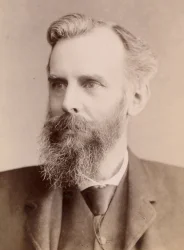
Josef Stefan
- A student from Carinthia
- The law that carried his name
- Teacher, scientific leader and poet
- A lasting scientific legacy
Josef Stefan was a physicist and mathematician whose name is now attached to a fundamental law of thermal radiation. Born to a Slovene family in the Austrian Empire, he rose from a modest childhood near Klagenfurt to become one of the leading figures at the University of Vienna. He was also a poet who wrote in Slovene, bringing together a scientific career in German-speaking academic life and a lasting connection to his family’s language.
A student from Carinthia
Stefan was born on 24 March 1835 in St. Peter, a village near Klagenfurt in Carinthia. His parents were Slovene and spoke Slovene at home. His father worked as a miller, and the family had limited means, but Stefan’s academic promise opened a path to further study. He attended secondary school in Klagenfurt, where he excelled, and in 1853 entered the University of Vienna.
He studied mathematics and physics, completing his doctorate in 1858. Even before graduating, he had begun publishing research. His early work attracted the attention of physiologist Carl Ludwig, who gave him access to a laboratory at Vienna’s Josephinum so he could pursue experiments. Stefan’s career advanced quickly: he became a lecturer in mathematical physics, a professor in 1863, and director of the University of Vienna’s Physics Institute in 1866.
The law that carried his name
Stefan investigated an unusually wide range of questions, from heat conduction in gases and fluid motion to electricity, optics and thermal radiation. His most famous result came in 1879, when he established experimentally that the total energy radiated by a black body rises in proportion to the fourth power of its absolute temperature. That relationship became known as the Stefan–Boltzmann law.
His student Ludwig Boltzmann later derived the same law theoretically, using ideas from thermodynamics and electromagnetic theory. The partnership between experiment and theory gave the result its familiar double name. The law became a useful tool for estimating the temperature of the Sun and other hot objects, and it contributed to the wider scientific inquiry into radiation that eventually helped lead toward quantum physics.
Stefan’s influence reached beyond the famous formula. His research on heat transfer and phase change helped shape later mathematical physics. A moving boundary in a melting or freezing problem is still described by what is known as the Stefan problem, a reminder of how his work connected abstract mathematics with physical processes.
Teacher, scientific leader and poet
At Vienna, Stefan was both a productive researcher and an influential teacher. Ludwig Boltzmann was among the young scientists who studied under him, and Stefan’s experimental approach helped nurture a generation of researchers. He served as director of the Physics Institute for many years and held senior roles in the Austrian Academy of Sciences, including vice-president.
His identity was not confined to the laboratory. Stefan wrote poetry and prose in Slovene, the language of his family and community, even as his scientific papers appeared primarily in German. His literary work reflected the cultural world he came from and the intellectual life he built in Vienna. He also took part in discussions about scientific standards, including work on the standard pitch used in musical tuning.
A lasting scientific legacy
Stefan’s health declined after a stroke in 1892. He died in Vienna on 7 January 1893, aged 57. His name endures in the Stefan–Boltzmann constant, the Stefan problem and the research institute in Ljubljana named in his honor.
His career bridged borders and disciplines. He was a Slovene from Carinthia working in the institutions of the Austrian Empire, an experimental physicist whose results were strengthened by mathematical theory, and a scientist who also valued poetry and language. The law associated with his name remains one of the clearest expressions of a deceptively simple idea: how intensely an object radiates depends dramatically on its temperature.