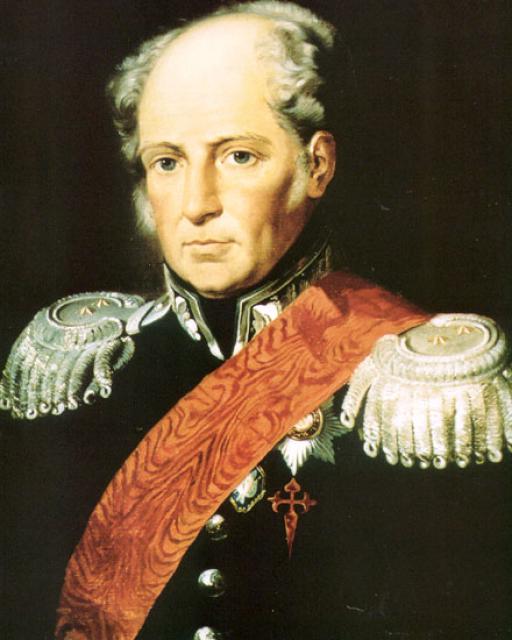
Agustin Betancourt
 Spain
SpainBiography of Augustin Betancourt
Augustin Betancourt was a scientist, engineer, architect, and urban planner. He was born into a noble Spanish family, and in 1417 his ancestor, French navigator Jean de Betancourt, conquered the Canary Islands and declared himself king.
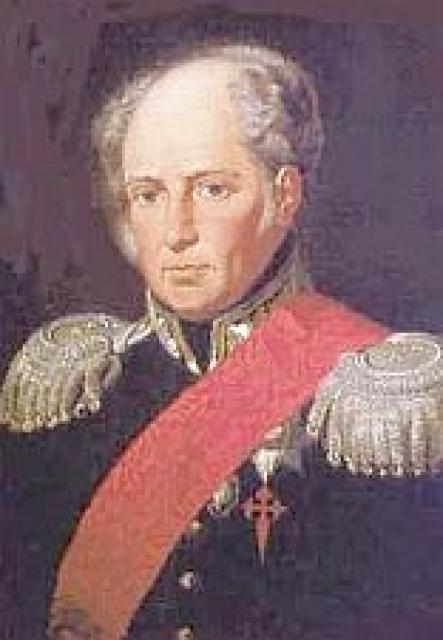
After receiving his education at the Royal Academy of Fine Arts in Madrid in 1781, Betancourt continued his studies at the Paris School of Bridges and Roads. During a trip to England, he became acquainted with steam engines. By the age of 30, Betancourt had become a prominent engineer-researcher, which contributed to his rapid career advancement. In 1788, he became the director of the Royal Cabinet of Machines in Madrid. In 1798, he was appointed the head of the construction of the first telegraph in Spain (Madrid-Cadiz). In his telegraph, he used binary coding of information, assigning each letter an 8-bit code, which anticipated Samuel Morse by 47 years.
From 1800 onwards, Betancourt served as the inspector general of the newly formed Corps of Communications, as well as all the roads and bridges in Spain. He also held positions such as Intendant of Provinces, member of the Council of Finance, and in 1803, he became the Chief Intendant of the Army and the General Director of the Post Office. Due to political changes in Spain in 1807, he left the country and moved to France. In 1808, he was invited by the Russian government to serve as a Major General in the Department of Communications.
During his 16 years of service in Russia, Betancourt made significant efforts to transform Russia into a technologically advanced country. Under his leadership, the Tula Arms Factory was re-equipped with steam engines based on his designs. He also constructed a new foundry for cannons in Kazan and modernized the Alexandrovsky cotton mill in Pavlovsk. He deepened the port in Kronstadt and built a canal between the Izhorsky Factory and St. Petersburg using a steam excavator he invented in 1810. In 1810, he established the Institute of Communications in St. Petersburg, which he led until the end of his life. He developed and proposed a curriculum that trained engineers in various fields to carry out any construction work. The main goal of the institution, according to Betancourt, was to "provide Russia with engineers who could be immediately assigned to work in the Empire." The institute he led laid the foundations for the future Russian engineering school.
Betancourt's organizational abilities as a talented engineer and inventor were recognized when he was appointed as the head of the Committee for Construction and Hydraulic Works in St. Petersburg in 1816, and later as the Chief Director of Communications in Russia in 1819. Under his plans and direct supervision, the Expedition for the Preparation of State Paper was built in 1818. The need for improved production of banknotes arose due to a large number of counterfeit notes in circulation after the war with Napoleon. A whole town was built to accommodate the papermaking department, printing department, mechanical, engraving, numbering, and form workshops, as well as offices and barracks for officials and employees.
At the same time, Betancourt worked on the technology of paper and banknote production. The paper produced by the Expedition soon received high praise for its quality and began to be exported. His work earned him the "highest favor" from Emperor Alexander I, and he was awarded the Order of St. Vladimir of the 2nd degree. He also participated in the construction of the Manege in Moscow, where he had to solve the challenge of covering a large area (166 x 45 meters) without intermediate supports to create a space suitable for inspections and parades. The construction proved to be strong, and soon a whole regiment of soldiers could march freely under its vaults. (The original name of the Manege was Exerzitsergaus).
In the early 19th century, Nizhny Novgorod became a center of international trade. Construction of the Nizhny Novgorod Fair began in 1817, and Betancourt was entrusted with choosing the location for the permanent fair. In 1820, according to his design, the Gostiny Dvor was constructed on the fairgrounds, and by 1821, the fair had become a large trading complex. The construction was completed by Betancourt's followers. The Spaso-Preobrazhensky Cathedral is the only building that remains from the fairgrounds.
In 1820, at Betancourt's initiative, the School for Conductors of Communications and the Military Construction School for training junior construction specialists, foremen, draftsmen, and craftsmen for the Department of Communications were opened. This laid the foundation for the state system of specialized technical education in Russia.
Betancourt was also one of the pioneers of bridge building in Russia. Stone bridges on the Moscow Highway, the Isaac's Plashkoutny Bridge over the Neva River, and the arch bridge over the Small Neva between Aptekarsky and Kamenny Islands in St. Petersburg were the fruits of his engineering thinking. He also participated in the construction of many other structures, including the first major highway in Russia, the Saint Petersburg - Novgorod - Moscow road (1818-1822), the Taitsky Aqueduct, the Mint in Warsaw, and the Georgievskaya Church at the Bolshoye Okhtinsky Cemetery in St. Petersburg.
Betancourt also invented the first machine for extracting mercury in mines, a device for cleaning technological coal, an optical telegraph, and was the first to launch a hot air balloon in Madrid. He developed a machine for wool production, invented and implemented a unique water excavator for that time, and also created a machine for underwater pile cutting. His contributions to Russia as a "Russian Spaniard" did not go unnoticed, and Betancourt was awarded the Order of St. Alexander Nevsky.
In 1823, his beloved daughter passed away suddenly, which greatly affected his health. In February 1824, he submitted his resignation. According to some reports, the resignation was initiated by Arakcheev. Betancourt passed away on July 14 of the same year. He was buried in St. Petersburg at the Smolensk Lutheran Cemetery. A majestic monument, made according to the drawings of Montferrand, was erected on his grave. It was a gift from the merchants of Nizhny Novgorod as a token of gratitude to the creator of the fair ensemble. In 1979, he was reburied in the Necropolis of the Alexander Nevsky Lavra.
In 1995, the Ministry of Communications of Russia established the Augustin Betancourt Memorial Medal. King Juan Carlos of Spain was awarded this medal with the number 2.
Betancourt resided in St. Petersburg at the following addresses: Fontanka Embankment, 115; Sadovaya Street, 50-a; Moskovsky Prospekt, 9; Bolshaya Morskaya Street, 19.


