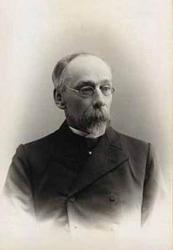
Philip Johnson
 USA
USABiography of Philip Johnson
Philip Johnson, one of the most prominent architects and the first laureate of the Pritzker Architecture Prize, was born on July 8, 1906, in Cleveland, Ohio. He came from a prominent family, with his father being a prominent lawyer. Johnson initially pursued classical philology and received his education at Harvard University.

In 1932, Johnson was appointed as the director of the Department of Architecture at the Museum of Modern Art in New York. Influenced by the museum's director, Alfred Barr, Johnson transitioned from being a classical philologist to becoming an advocate for what he and architectural critic Henry-Russell Hitchcock called the "international style." Together with Hitchcock, Johnson published a book that defined the characteristics of this style.

Inspired by his work in architecture propaganda, Johnson decided to pursue architecture as a career. In 1940, he enrolled in the Harvard Graduate School of Design under the guidance of Marcel Breuer to fully dedicate himself to the profession. He completed his architectural studies in 1943.
Johnson's early works strongly resembled those of his famous teacher, Mies van der Rohe. His own constructions in this period, such as the Glass House in New Canaan, Connecticut, and St. Thomas University in Houston, showcased a blend of industrial classicism and romantic classicism.
In the 1950s and 1960s, Johnson's style began to evolve. His designs, such as the William Proctor Museum in Utica and the Sculpture Garden at the Museum of Modern Art in New York, incorporated elements of neoclassicism and showcased his innovative approach to movement and space.
In the 1970s, Johnson's firm, "Johnson/Burgee Architects," became a leading voice in American architecture, gaining recognition for their expertise and association with the elite. Johnson himself became a highly influential and fashionable architect, synonymous with refinement and luxury.
One of the most controversial projects in Johnson's career was the design of the "American Telephone and Telegraph" (AT&T) skyscraper in Manhattan. The building, characterized by its grand scale, was heavily criticized for its historical references and rococo-inspired design. Despite the backlash, Johnson maintained an air of composure and politeness.
Throughout the 1980s, Johnson continued to create diverse and distinctive designs, defying categorization within a specific architectural style. His works during this period, including the Republic Bank Center in Houston, showcased his postmodern tendencies and romanticized architectural elements.
In the mid-1980s, Johnson gained significant attention for his project at Times Square in New York. The four high-rise towers surrounding the subway pavilion, featuring limestone screens overlaid on glass facades, were praised for their unique design and use of space.
In addition to his architectural contributions, Johnson's personal life and worldview were also of interest. He was open about being gay, and in his youth, he was an ardent supporter of Nazism. Later in life, he renounced his previous views, acknowledging them as a "foolish mistake."
Philip Johnson passed away on January 26, 2005, at his home in New Canaan, Connecticut. His legacy as an architect continues to influence and inspire generations of architects around the world.