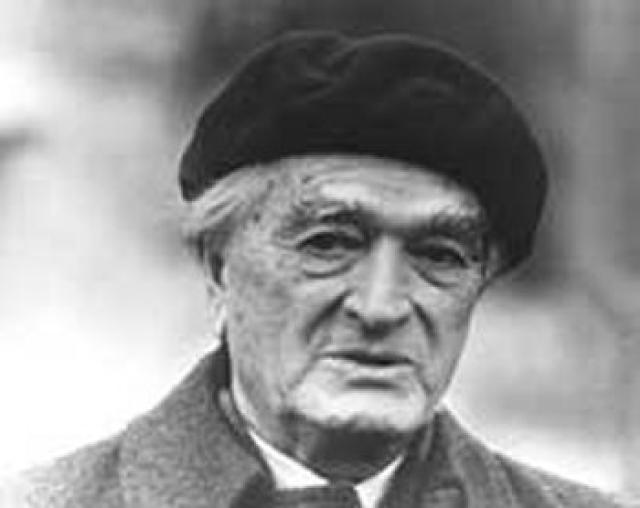
Ahmed Saygun
 Turkey
Biography of Ahmed Saygun
Ahmed Adnan Saygun was a Turkish composer, musicologist, and educator, and one of the founders of the national music school. Born in 1907, he was the son of a mathematics teacher. At the age of 13, Saygun began to learn music on his own and with the help of a private tutor. He received a scholarship to study at the Schola Cantorum in Paris under Vincent d'Indy from 1928 to 1931. In 1934, he became the conductor of the Presidential Orchestra and started teaching at the Istanbul Conservatory in 1936.

In the same year, Saygun traveled with Béla Bartók throughout Anatolia, collecting folk songs. He served as a musical advisor to the Republican People's Party of Turkey and was one of the founders of the Institute of Folklore Studies in 1955. From 1964 to 1972, he taught composition at the Ankara Conservatory and later taught musical ethno-logy and composition at the Istanbul State Conservatory.
Contribution to Turkish Music
Saygun's work was stimulated by the cultural construction program initiated by Atatürk, which aimed to synthesize national and scholarly, Turkish and European music. The Times newspaper noted in his obituary that Saygun was "to his country what Jean Sibelius was to Finland, Manuel de Falla to Spain, and Béla Bartók to Hungary."
After his death, the Saygun Center for Musical Research was established at Bilkent University in Ankara. Saygun composed five operas, including "Köroğlu" (1973) and "Gilgamesh" (1962-1983), which were the first Turkish polyphonic operas. He also composed two ballets, five symphonies, violin and viola concertos, a chamber concert for strings, as well as other orchestral, choral, and chamber works.
International Recognition
Saygun gained international recognition for his oratorio "Yunus Emre," which was performed by the Lamoureux Orchestra at the Salle Pleyel in Paris in 1947. The oratorio was translated into several languages and widely performed worldwide. In 1958, it was recorded by the NBC Symphony Orchestra conducted by Leopold Stokowski. Saygun's compositions are performed in Europe and Russia, with notable performances including the State Symphony Cinema Orchestra playing his First Piano Concerto with soloist Igor Zhukov.
In 1949, Saygun was awarded the Palmes académiques by the French Ministry of Education. He also received the Friedrich Schiller Medal in Germany in 1955, along with many other national and international honors, including an award from the Hungarian government for his collaboration with Bartók. In 2003-2004, all four of Saygun's string quartets were recorded by the renowned Belgian ensemble, Quatuor Daniel.


