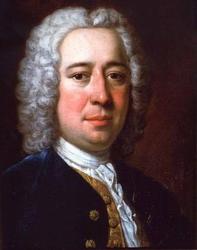
Alfred Newman
 USA
USA- The Early Life and Musical Promise of Alfred Newman
- A Multifaceted Artist
- Conducting and Broadway Success
- Hollywood and Cinematic Music
- "The Diary of Anne Frank" and Musical Impact
- A Legacy of Excellence
- Nurturing New Talent
- A Titan in the World of Music
- Personal Life and Family Legacy
The Early Life and Musical Promise of Alfred Newman
Alfred Newman, a prominent American composer, arranger, and conductor, was born on March 17, 1900, in New Haven, Connecticut. As the eldest of ten children born to Russian-Jewish immigrants, his musical talent emerged at an early age. His father, Michael, had been a cantor in Russia, and at the age of five, Alfred began taking piano lessons.

Despite financial difficulties that forced his parents to sell their dog, Alfred's musical abilities quickly drew attention. By age eight, he was recognized as a child prodigy pianist, and his talent was further nurtured by renowned virtuoso Ignacy Jan Paderewski, who assisted Alfred in securing a performance at Carnegie Hall in New York City.

A Multifaceted Artist
Throughout his youth, Newman continued his musical education under the tutelage of Sigismund Stojowski, Alexander Lambert, Rubin Goldmark, and George Wedge, mastering harmony, counterpoint, and composition. By the age of 12, he sought ways to contribute to his family's income, performing in theaters and restaurants. For a time, he served as a regular accompanist for vaudeville star Grace La Rue, traveling with her on tour.
Conducting and Broadway Success
Newman's conducting career began at the age of 15 when he regularly led performances during matinee shows. By age 19, he had become a full-fledged conductor in New York City, embarking on a decade-long Broadway career. He conducted musicals by George Gershwin, Richard Rodgers, and Jerome Kern.
Hollywood and Cinematic Music
In 1930, Newman received an invitation to accompany Irving Berlin in Hollywood for the film "Reaching for the Moon." Despite disagreements between Berlin and the director, Edmund Goulding, which resulted in most of Berlin's music being removed, this experience marked Newman's first venture into Hollywood.
Over the next four decades, Newman would compose musical scores for nearly 200 films, including renowned works such as "Wuthering Heights," "Mark of Zorro," "The Song of Bernadette," "All About Eve," "How the West Was Won," and "The Greatest Story Ever Told." From 1940 to 1960, he headed the music department at 20th Century Fox, where he developed the "Newman Scoring System," which synchronized film action with musical underscoring, and is still widely used today.
"The Diary of Anne Frank" and Musical Impact
In 1959, Newman provided the original score for "The Diary of Anne Frank." The film's music employed "uplifting violins" and "old-fashioned European music" for scenes centered on Anne, while creating a "long, somber march" for the Nazis, eliciting a haunting effect. Music historian Christopher Palmer lauded the score as one of Newman's finest, saying it "allows the viewer to feel physically" the emotions portrayed by the actors.
A Legacy of Excellence
Newman passed away on February 17, 1970, at 69 years of age, from complications of emphysema. Music historians often refer to his word as "law" in Hollywood music for nearly three decades. He, along with fellow composers Max Steiner and Dimitri Tiomkin, was dubbed one of the "three godfathers of film music."
Newman composed the renowned fanfare sound logo for the 20th Century Fox logo, which introduces every film released by the studio. His musical cue for David O. Selznick's adventure film "The Prisoner of Zenda" (1937) became the logo music for Selznick International Pictures.
In 1999, the 280-seat Allan Hancock Auditorium at the University of Southern California was renovated and rededicated as the Alfred Newman Concert Hall.
Nurturing New Talent
Newman was known for his generosity in mentoring and advancing the careers of aspiring talent in cinematic music. Among those he supported were Bernard Herrmann, David Raksin, and John Williams.
Producer Nick Redman said, "Alfred Newman's legacy and his influence on the language of music in film have few parallels in Hollywood history. As an executive, he could be challenging yet fair; as a mentor, he inspired loyalty amongst his staff."
A Titan in the World of Music
"Orchestras reveled in his conducting; the music that poured out of him, often under great emotional stress, is some of the most gorgeous ever written..." Redman added. "For all his diminutive stature, Newman was a towering figure, a Titan in a world he loved and dominated. He was a musical force of nature, and one for which there will never be an adequate replacement."
Personal Life and Family Legacy
Alfred Newman was married to Martha Montgomery, a former actress and dancer with The Goldwyn Girls. She passed away in 2005. The couple had five children.
Sons Thomas Newman and David Newman are renowned composers, with Thomas having received 13 Academy Award nominations. Daughter Maria Newman is an accomplished musician and composer.
Grandson Joey Newman creates music for television series, films, and video games. Granddaughter Jaclyn Newman Dorn is a music editor, winning a Golden Reel Award for her work on the horror film "30 Days of Night: Dark Days."