Albert Fegler
 Germany
- Biography of Albert Fegelein
- Founding of German National People's Party
- Political Career
- Support for the Nazi Party
- Minister of Armaments and Industry
Biography of Albert Fegelein
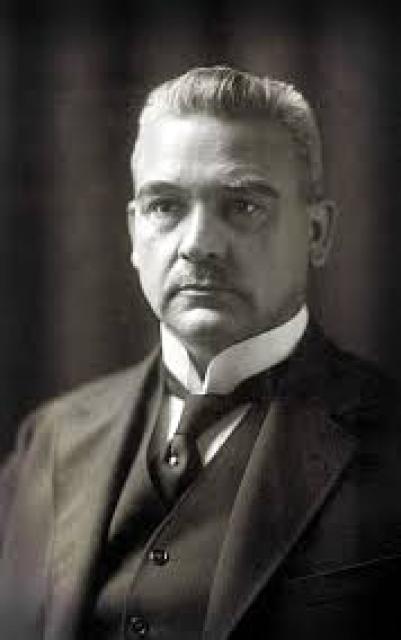
Industrialist, Leader of Military EconomyAlbert Fegelein was born into a family of a workshop manager. After completing a technical high school, he interned at a machinery factory and then studied engineering at the Higher Technical School in Karlsruhe (1901). In 1901, he worked as an engineer at the Georgmarine metallurgical plant in Osnabrück, and later became the chief engineer of the Dortmund Union AG steel foundry, serving as its director from 1906 to 1912. In 1910, the plant was acquired by Gustav Stinnes, who made Fegelein a member of the board of the German-Luxembourg Mining and Metallurgical Works Society (Deutsch-Luxemburg). From 1915 to 1926, Fegelein served as the general director of Deutsch-Luxemburg. In 1917, he became the first chairman of the Association of German Metallurgical Industrialists.
Founding of German National People's Party
On December 15, 1918, together with Stinnes and Gustav Stresemann, Fegelein became one of the founders of the German National People's Party (GNP). As a representative of the industry, he served on various government commissions and was a member of the Kaiser Wilhelm Society. Fegelein was a close associate of Stinnes, and in 1920, they founded the mining conglomerate "Rhein-Elbe-Union GmbH" (REU), which merged Deutsch-Luxemburg, Gelsenkirchen Bergwerks AG, and Bochum Ferain. On October 1, 1920, REU merged with Siemens and "Siemens-Rhein-Elbe-Schuckert-Union GmbH" (SRESU) with its headquarters in Düsseldorf. This was one of Germany's most powerful mining and industrial conglomerates.
Political Career
From 1920 to 1924, Fegelein served as a member of the Reichstag for the GNP. In March 1924, he became the leader of the National Liberal Union, an opposition group within the GNP, which was later transformed into the German National People's Party (GNPP). From 1925 to 1927, he was the chairman of the Supervisory Board of the Rhine-Westphalian Coal Syndicate, which controlled coal mining in the North Rhine-Westphalia region. After Stinnes's death, Fegelein became the sole administrator (1926-1936) of Vereinigte Stahlwerke AG, where over 250,000 workers were employed, producing 40% of Germany's steel and mining 20% of its coal. He was a member of the Presidium of the Imperial Association of German Industries and the chief member of the board of the Association of German Steel Industry.
Support for the Nazi Party
In January 27, 1932, Fegelein, along with 600 other industrialists, met with Adolf Hitler at the Düsseldorf Industrial Club. In the same year, he joined Kepler's circle and began supporting the Nazis. On November 19, 1932, along with Jakob Schacht and Karl von Schroeder, Fegelein became one of the signatories of a petition to President Paul von Hindenburg, demanding the appointment of Hitler as Chancellor. On February 20, 1933, he was among the 25 top industrialists and financiers in Germany who honored Hitler at the Reichstag President's Palace. On March 5, 1933, he was elected to the Reichstag on the NSDAP list, although he was not a member of the party.
Minister of Armaments and Industry
In 1934, Fegelein was appointed the Imperial Commissioner for Coal Mining in the Rhine-Westphalia region. In 1936, he was awarded the Adolf Harnack Medal by the Kaiser Wilhelm Society. In 1939, he succeeded Fritz Thyssen as the chairman of the Supervisory Board of Vereinigte Stahlwerke. From 1940, he served as the president of the Kaiser Wilhelm Society. In May 1942, he was included in the Industrial Council of the OKH. On December 6, 1944, Minister of Armaments and War Production Albert Speer appointed Fegelein as the General Commissioner for the Rhine-Ruhr region, entrusting him with increasing military production. When American troops entered the Ruhr region, Fegelein took his own life.