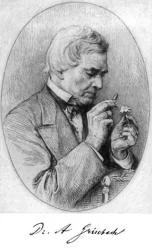
Albert Gottfried Dietrich
Albert Gottfried Dietrich helped document the plants of Prussia at a time when regional botany depended on field observation, careful illustration, and the exchange of specimens. Trained first as a pharmacist and later in medicine, he made his way into botanical science through years of self-directed study. His twelve-volume Flora Regni Borussici became the defining work of his career, combining detailed descriptions with hundreds of botanical plates.
Early life and education
Dietrich was born in Danzig on 8 November 1795, the son of a merchant. His father died when he was young, and the family’s limited means shaped his education and working life. He apprenticed at a pharmacy in Danzig, where practical exposure to medicinal plants strengthened his interest in botany. After moving to Berlin, he studied medicine at the university from 1816 to 1820, but could not afford to complete the doctorate he had hoped to earn.
During these years, Dietrich continued studying plants independently, often learning through long walks and field excursions. A local flora he published helped bring his botanical work to wider notice. At age 29, he secured a position teaching botany at the newly established gardening school in Schöneberg, near Berlin.
Botany for gardeners and scholars
Dietrich’s career joined scientific study with practical horticultural education. In 1835 he became curator at Berlin’s Royal Botanical Garden, while continuing to teach and to work with botanical and zoological collections. His teaching focused on making botanical knowledge useful to gardeners, and he wrote illustrated manuals that explained plant terminology and botany in accessible terms. Terminologie der phanerogamischen Pflanzen, first published in 1829, used hundreds of figures to explain flowering-plant structures; later editions expanded the illustrations. His three-volume Botanik für Gärtner und Gartenfreunde (Botany for Gardeners and Garden Lovers, 1837–1839) likewise brought scientific knowledge to a practical audience.
His largest undertaking was Flora Regni Borussici, published in twelve volumes from 1833 to 1844. The work described and illustrated the wild plants of the Prussian kingdom. Dietrich drew the plates himself, with careful attention to diagnostic details, including roots. In the twenty-first century, botanists have revisited the illustrations as evidence of historic plant distributions: a 2025 study noted that some plates document specimens from the Moselle, Nahe, and Middle Rhine valleys, providing a valuable record of plants collected before continuous regional surveys were established.
Dietrich also helped found and edit the Allgemeine Gartenzeitung, a periodical on gardening and horticulture, with Friedrich Otto. He worked on it from 1833 until his death. The botanical author abbreviation “A. Dietr.” is used in scientific plant names, and nearly five hundred species are associated with his authorship in botanical reference lists.
Professional setbacks and legacy
Despite his major publications, Dietrich’s academic career remained precarious. His teaching post and work with collections were poorly paid, and he took on additional duties to support his family. In 1853 he was dismissed from the gardening school. Contemporary accounts suggest that professional disagreements and personal frictions may have contributed, although the precise reasons are not clear from the surviving evidence.
Dietrich died in Berlin on 22 May 1856, aged 60. His work combined field botany, scientific illustration, and horticultural instruction, preserving detailed observations of plants across a wide territory. Though Flora Regni Borussici received less lasting attention than its scale might suggest, its plates and descriptions continue to assist researchers tracing changes in regional flora and to show the care with which he pursued his subject.