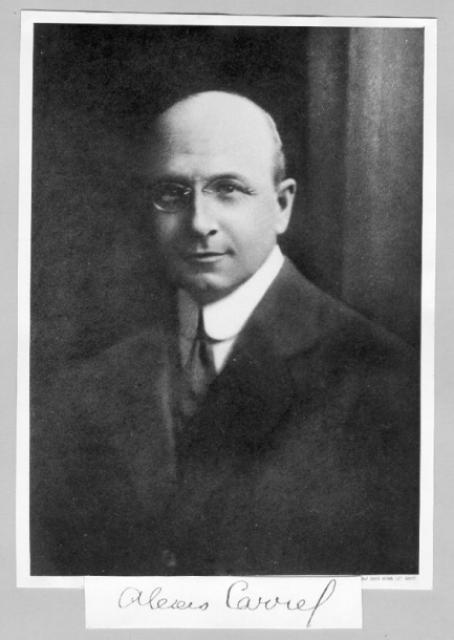
Aleksis Carrel
 France
- Early Life and Education
- Surgical Innovations
- Transatlantic Collaborations and Nobel Prize
- Wartime Contributions and Legacy
- Controversial Theories and Later Years
- Recognition and Honors
Alexis Carrel: A Pioneer in Vascular Surgery and Organ Transplantation
Early Life and Education
Alexis Carrel was born in Sainte-Foy-lès-Lyon, France, in 1873. Growing up in a religious environment, he developed an early interest in science and medicine, experimenting with chemistry and dissecting birds. Despite not being an exceptional student, Carrel earned two bachelor's degrees before entering medical school in Lyon.
Surgical Innovations
After obtaining his medical degree in 1900, Carrel spent time in various hospitals, where he honed his surgical skills. Inspired by the tragic death of President Marie François Sadi Carnot due to a hemorrhage, Carrel dedicated himself to finding a way to repair damaged blood vessels. He developed an innovative technique known as end-to-end anastomosis, which involved turning back the edges of cut vessels and sewing them together with fine needles and silk thread.
Transatlantic Collaborations and Nobel Prize
Despite his groundbreaking advancements, Carrel faced resistance from the medical establishment in Lyon. Discouraged, he moved to Paris in 1903 and later immigrated to Canada. However, he was soon invited to join the University of Chicago's Department of Physiology. During his time in Chicago, Carrel perfected his surgical techniques and performed the first successful organ transplantations, which became possible due to his pioneering method of vessel anastomosis.
In 1906, Carrel joined the newly established Rockefeller Institute for Medical Research in New York City. There, he continued his experiments in organ transplantation, achieving significant advances in the grafting of blood vessels, kidneys, and even limbs. In 1912, he was awarded the Nobel Prize in Physiology or Medicine for his contributions to vascular suture and vessel and organ transplantation.
Wartime Contributions and Legacy
During World War I, Carrel served in the French medical corps, where he applied his surgical expertise to the treatment of wounded soldiers. He collaborated with biochemist Henry D. Dakin to develop a mild antiseptic known as the Carrel-Dakin solution, which helped reduce the incidence of gangrene.
Carrel's work on tissue culture also gained attention. He and his colleagues successfully maintained a line of connective tissue cells for over 24 years, laying the foundation for later research in cell biology and virology. However, it was not until after his death that his contributions in this area found widespread application.
Controversial Theories and Later Years
In his later years, Carrel proposed a grand plan for improving human life through a "Supreme Council" of intellectuals. These ideas were met with mixed reactions and accusations of eugenics and elitism. Carrel's association with the Vichy government during World War II further tarnished his reputation.
After the war, Carrel returned to France and founded the Institute for the Study of Human Problems with the support of the Vichy regime. However, the institute was dissolved after the liberation of France in 1944. Carrel's involvement with this organization remains a contentious issue to this day.
Recognition and Honors
Carrel was a member of numerous scientific societies and received honorary doctorates from universities worldwide. He was awarded the Legion of Honour for his wartime service and was recognized with various other medals and titles from nations such as Belgium, Sweden, and the Vatican.
Alexis Carrel passed away in Paris in 1944, leaving behind a legacy of groundbreaking advancements in vascular surgery and organ transplantation. Despite his later controversies, his contributions to medicine continue to inspire and shape the field today.