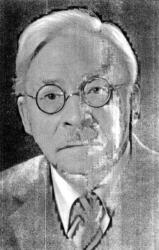
Alexander Andreev
- Aleksandr Ignatyevich Andreyev: A Comprehensive Biography
- Career at the Academy of Sciences
- Academic Activities and Repression
- Reestablishment and Contributions
- Legacy and Impact
Aleksandr Ignatyevich Andreyev: A Comprehensive Biography
Early Life and EducationBorn on March 12 (24), 1887, in St. Petersburg, Russia, Aleksandr Ignatyevich Andreyev was the son of a merchant family. After completing his studies at the Petrozavodsk Commercial School in 1907, he enrolled as a part-time student at the St. Petersburg University, where he was awarded a scholarship from the St. Petersburg Merchant Society. In 1908-1909, he briefly attended the economic department of the St. Petersburg Polytechnic Institute.
Career at the Academy of Sciences
In 1913, Andreyev joined the Permanent Historical Commission of the Academy of Sciences, where he was invited by its chairman, A. S. Lappo-Danilevsky. He prepared the collection "Gramota Kollegii Economii" for publication and later served as the scientific secretary of the commission. In 1926, after its merger with the Archaeological Commission, he became a member of the Permanent Historical and Archaeological Commission of the USSR Academy of Sciences.
Academic Activities and Repression
Andreyev also lectured at the Archaeological Institute (1919-1927) and Leningrad State University (1919-1927). In 1918-1925, he worked at the Central Archives of the People's Commissariat of Railways. However, his career was interrupted in 1929 when he was arrested during the "Academic Affair." In 1931, he was sentenced to five years of exile in the Krasnoyarsk Region.
Reestablishment and Contributions
After his release in 1935, Andreyev returned to Leningrad and resumed his work in the Institute of Northern Peoples and the Institute of Ethnography of the USSR Academy of Sciences. He also became a member of the Geographical Society in 1938. In 1940, he successfully defended his doctoral dissertation on "Essays on the Source Studies of Siberia in the 17th-18th Centuries."
During and after World War II, Andreyev played a significant role in historical research. He evacuated to Kazan and Tashkent, where he became a staff member of the Institute of History of the USSR Academy of Sciences. He later headed the Department of Auxiliary Historical Disciplines at the Moscow State Historical and Archival Institute (1943-1949) and became a professor in 1945.
Legacy and Impact
Throughout his career, Andreyev made invaluable contributions to the study of Northern and Siberian history. His publications and edited works on these topics include "Runaway Charters: On the History of Peasant Land Ownership in the North in the 16th Century." He meticulously prepared and published the works of the 18th-century historian G. F. Miller and dedicated significant research to the life and writings of the Siberian historian, geographer, and ethnographer Semyon Remezov.
Andreyev's "Essays on the Source Studies of Siberia" remains a foundational work in the field. Despite facing criticism and political opposition, he continued to pursue his research interests until his death. His contributions to the advancement of historical knowledge continue to be recognized and valued by scholars and historians today.