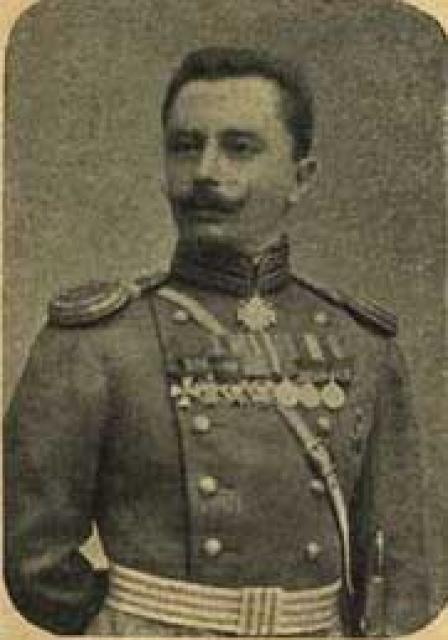
Alexander Anoev
 Russia
Early Life and Military Education
General Major, who served with distinction in both the Russo-Japanese War and World War I, began his military career at an early age. He graduated from the 2nd Moscow Cadet Corps and the Alexander Military School.
Russo-Japanese War
In 1894, General Major joined the 18th Artillery Brigade. Upon mobilization in 1904, he was transferred to the 4th East Siberian Rifle Artillery Brigade.
From May to December 1904, he participated in the defense of Port Arthur. Notably, on May 13, 1904, he defended the position at the Kinzhou isthmus. In July 1904, he was dispatched from Port Arthur to Liaoyang with a report for General Kuropatkin. During this daring mission, he broke through the enemy naval blockade and returned with orders for the commanding officer.
Throughout the siege of Port Arthur, General Major demonstrated exceptional valor. He commanded artillery on various fronts, including the Wolf Mountains and the Tahe redoubt. During the Japanese assaults on Fort No. 3, he was severely wounded and evacuated to a hospital. However, on December 20, 1904, he was captured and taken prisoner to Japan.
World War I
In 1914, General Major, now a colonel, commanded a battery in the 27th Artillery Brigade. He participated in the Battle of Gumbinnen in East Prussia and various other battles throughout the region.
During the German retreat in February 1915, he was encircled in the Augustow Forests and taken prisoner during an attempted breakout at Grodno. After escaping from captivity, he was detained at the Dutch border and spent 20 months in solitary confinement.
Post-War Service
Upon his release in 1918, General Major volunteered for the White Army and delivered a report to General Denikin. He was then sent to Tbilisi to gather intelligence on Russian artillery assets. However, he was arrested by Georgian authorities and imprisoned until his release by the British.
General Major returned to active duty in the White Army and served in various roles. He was arrested again in January 1919, but was later released. In May 1919, he was appointed Chairman of the Commission for the Export of Russian Military Equipment from Trapezund.
Later Years
In June 1920, General Major fled Trapezund amid threats from Kemalists and the risk of extradition. He arrived in Constantinople and eventually made his way to Sevastopol to report on his mission. Promoted to General Major in August 1920, he remained in the Middle East after the evacuation of Crimea.
General Major served with the British in the inspection of British military cemeteries and later with the Russian Red Cross. He moved to France in the late 1920s and passed away in Paris in 1931. He was laid to rest in the cemetery of Villejuif, a suburb of Paris.