Alexander Drevin
 Russia
- Aleksandr Drevin: The Latvian Avant-Garde Artist
- Avant-Garde Movement
- Post-Revolution and Teaching
- Travels and Landscapes
- Tragic End and Legacy
Aleksandr Drevin: The Latvian Avant-Garde Artist
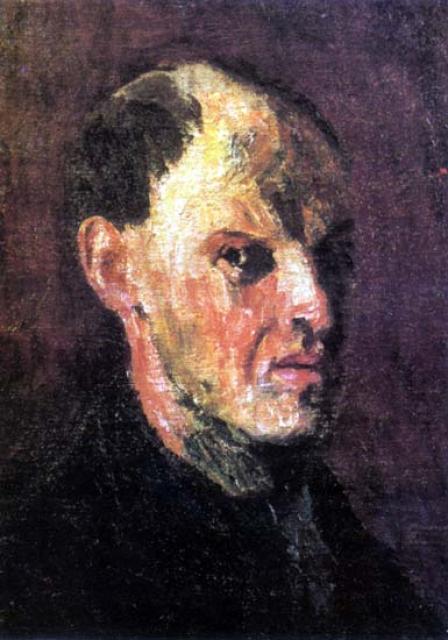
Early Life and EducationAleksandr Drevin, a Russian artist of Latvian descent, was born into a working-class family. At the age of fifteen, he enrolled in a maritime school in Riga, Latvia. Later, from 1908-1913, he studied at the Riga City Drawing School under the tutelage of Voldemārs Purvītis.
Avant-Garde Movement
By the mid-1910s, Drevin became captivated by modernist trends in painting. In 1914, he joined the avant-garde group "Green Flower" (Zaļā puķe), established by young Latvian artists. However, shortly after its inception, he was forced to leave Riga with his family and relocate to Moscow, where he joined the "Jack of Diamonds" group.
Post-Revolution and Teaching
After the October Revolution, Drevin led an art studio for Latvian sharpshooters under the National Latvian Commissariat. There, he reunited with his fellow "Green Flower" member Kārlis Johansons. His artistic talents caught the attention of Kazimir Malevich, and Vladimir Tatlin offered him a position in the Department of Visual Arts of the People's Commissariat for Education.
From 1920 onwards, Drevin taught at Vkhutemas-Vkhutein, serving as head of the workshop until its closure in 1930. Subsequently, he devoted himself exclusively to painting, becoming part of the artistic group "Thirteen" in 1931.
Travels and Landscapes
Throughout the mid-1920s, Drevin and his wife, the artist Nadezhda Udaltsova, extensively traveled throughout the Soviet Union. They created numerous landscapes depicting the Ural Mountains, the Altai region, Eastern Kazakhstan, and Armenia.
Tragic End and Legacy
On January 17, 1938, Drevin was arrested as part of a fabricated conspiracy case targeting Latvian sharpshooters. After a brief interrogation, he was executed at the Butovo firing range. During his arrest, his wife managed to conceal his paintings from confiscation by passing them off as her own. The artworks were first exhibited in Moscow in 1971.