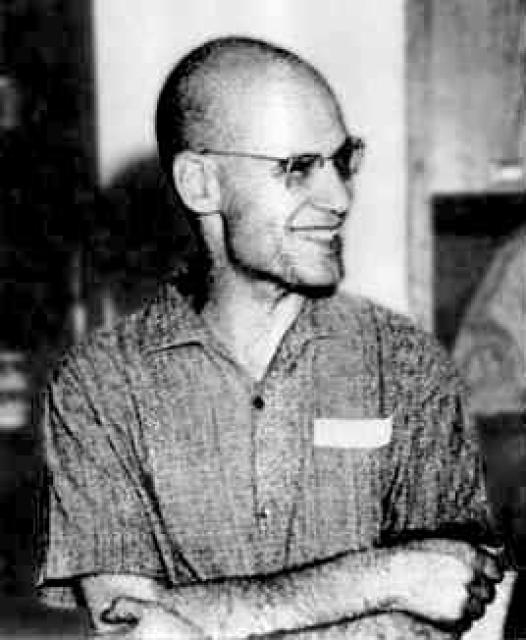
Alexander Grothendieck
 France
- Biography of Alexandre Grothendieck
- Childhood and Internment
- Education and Career
- Contributions and Legacy
Biography of Alexandre Grothendieck
Early LifeAlexandre Grothendieck, a brilliant French mathematician, was born to anarchist parents and grew up in a family of activists. His father, Alexander Shapiro, was a Russian refugee who fled to France after being sentenced to death for his involvement in the 1905 revolution. His mother, Johanna Grothendieck, was a German-born anarchist who moved to Berlin to pursue her interests in avant-garde art and politics.
Childhood and Internment
Due to persecution under the Nazi regime, Grothendieck's parents sent him to live with a foster family in Hamburg, Germany, just before the start of World War II. In 1940, both of his parents were interned, with his father tragically dying in the Auschwitz concentration camp. Grothendieck and his mother were sent to an internment camp in Rieucros, France, where he attended school in a nearby town.
Education and Career
Despite the challenges of his upbringing, Grothendieck showed immense talent in mathematics. After the war, he studied at the University of Montpellier in France, where he faced financial hardships and worked as a grape picker to support himself and his mother. Despite discouragement from a professor who believed mathematics was a nearly complete field, Grothendieck independently delved into measure theory and made significant contributions to the field.
In 1948, Grothendieck moved to Paris to continue his mathematical education. He gained the attention of renowned mathematician Henri Cartan and began attending his seminars at the École Normale Supérieure. Grothendieck's brilliance and independent discoveries in measure theory impressed his mentors, leading to further opportunities and collaborations.
Contributions and Legacy
In the late 1950s, Grothendieck made groundbreaking contributions to algebraic geometry, introducing the theory of schemes, which revolutionized the field. His seminal work, "Elements of Algebraic Geometry," co-authored with Jean Dieudonné, became a staple in the field and solidified his reputation as a leading mathematician.
Grothendieck's unyielding commitment to social justice and opposition to oppression led him to decline prestigious honors and participate in political activism. He boycotted the 1966 International Mathematical Congress in Moscow in protest of the Soviet Union's suppression of dissent. Instead, he traveled to Vietnam to teach topology to students affected by the war.
Later in his life, Grothendieck became disillusioned with the mathematical community, citing exploitation and a lack of recognition for young mathematicians. He shifted his focus to biology, ecology, and esoteric interests. His controversial actions, such as providing housing to an undocumented immigrant, led to legal troubles and a loss of support from some former colleagues.
Grothendieck ultimately isolated himself from the mathematical world and lived in seclusion in the Pyrenees region of France. Access to him was limited to a select group of twelve mathematicians. Despite his reclusive lifestyle, Grothendieck's contributions to mathematics continue to influence and inspire future generations.


