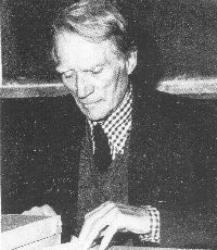
Abraham Robinson
 USA
USA- Biography of Abraham Robinson
- Early Life and Education
- World War II and Career
- Contributions and Legacy
- Later Years and Death
Biography of Abraham Robinson
Abraham Robinson, an American mathematician, is widely known for his development of "non-standard analysis," a mathematically rigorous system that implements Leibniz's idea of the existence of infinitesimal quantities that are distinct from zero.
Early Life and Education
Abraham Robinson was born on October 6, 1918, in Waldenburg, Germany (currently Wałbrzych, Poland). He grew up in a Jewish family with strong Zionist beliefs. His father, a chemist by profession, worked as a writer but passed away shortly after Abraham's birth. In 1933, when the Nazis came to power, fifteen-year-old Abraham and his mother and brother moved to Palestine. There, he earned his first degree at the Hebrew University in Jerusalem, which he graduated with honors.
World War II and Career
During World War II, Robinson found himself in France when the Nazis invaded its territory. He had to flee, both by train and on foot, and was repeatedly interrogated by French soldiers due to his German passport. His passport and map were more detailed than theirs, raising suspicion. Eventually, Abraham arrived in London, where he joined the "Fighting France" movement and became an expert in supersonic aerodynamics and flight. However, he never forgot his mathematical research on mathematical logic.
After the war, Robinson worked in London, Toronto, and Jerusalem until 1962 when he joined the University of California, Los Angeles (UCLA). He became known for his approach using methods of mathematical logic to solve problems in analysis and abstract algebra. He introduced many of the "fundamental concepts of model theory." Using these methods, Robinson found a way to use formal logic to demonstrate what a self-consistent non-standard model of the system of real numbers, including infinitesimal numbers, looks like. Other brilliant minds, including Wilhelmus Luxemburg, achieved similar results in their research, confirming that arithmetic operations in the spirit of Leibniz can be performed with infinitesimal numbers without introducing the concept of limits. By using ultrapowers, other mathematicians made Robinson's work more accessible to those without formal logic training.
Contributions and Legacy
Abraham Robinson's book, "Non-standard Analysis," was published in 1966. He had a strong interest in the history and philosophy of mathematics, often mentioning his desire to delve into Leibniz's mind to formulate the concept of infinitesimal numbers clearly. Robinson authored a total of 9 books and around 130 articles, covering various areas of fundamental and applied mathematics. His colleagues at UCLA particularly remember him for his efforts to accommodate students with different abilities and find projects of appropriate levels of difficulty for each of them. He succeeded in earning the favor of Yale University, where he transferred in 1967.
Later Years and Death
Abraham Robinson passed away from pancreatic cancer on April 11, 1974, at the age of 55, in New Haven, Connecticut.