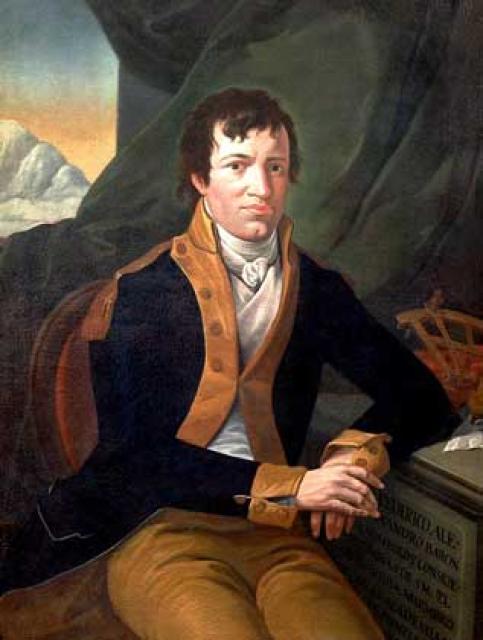
Alexander von Humboldt
 Germany
- Alexander von Humboldt
- Early Life and Education
- Explorations in Central and South America
- Contributions and Legacy
Alexander von Humboldt
Alexander von Humboldt (1769-1859) was a German naturalist, geographer, and explorer. He was born on September 14, 1769, in Berlin. Initially, Humboldt intended to become a government official and enrolled at the University of Frankfurt-on-the-Oder in 1787. However, he soon developed a keen interest in the natural sciences.
Early Life and Education
In 1789-1790, Humboldt embarked on a journey through the Rhine Valley and France. He then studied at the Hamburg Trade Academy from 1790 to 1791, followed by the Freiberg Mining Academy, where he received a degree in mining engineering in 1792. During 1792-1795, he worked in the mining department while simultaneously pursuing botany, mineralogy, and chemistry.
Explorations in Central and South America
From 1799 to 1804, Humboldt undertook extensive travels in Central and South America. His experiences during this expedition resulted in his renowned publication, "Voyage to the Equinoctial Regions of the New Continent" (Voyage aux régions équinoxiales du Nouveau continent). In 1808, he published "Views of Nature" (Ansichten der Natur), which introduced the concept of the close connection between climate and vegetation.
Contributions and Legacy
Humboldt's scientific interests were remarkably diverse. His main objective was to comprehend nature as a whole and gather evidence of the interactions between natural forces. He developed scientific disciplines such as physical geography, landscape studies, and plant geography. Humboldt dedicated significant attention to the study of climate, developing the isotherm method and creating a map of their distribution. His work on gases, conducted in collaboration with Jean-Baptiste Biot, contributed significantly to the understanding of atoms and molecules.
Humboldt's extensive research laid the foundations of geomagnetism and made significant contributions to the field of climatology. In 1827, he delivered lectures at the University of Berlin and subsequently embarked on a journey across Russia in 1829, exploring the Ural Mountains, Altai Mountains, Caspian territories, and the Caspian Sea. The outcome of this expedition was his three-volume work "Central Asia" (Asie Centrale), published in 1843. In 1845, he published "Cosmos: A Sketch of a Physical Description of the Universe" (Kosmos: Entwurf einer physischen Weltbeschreibung).
Alexander von Humboldt passed away in Berlin on May 6, 1859. His extensive explorations, scientific contributions, and interdisciplinary approach continue to inspire and influence scientists and researchers to this day.


