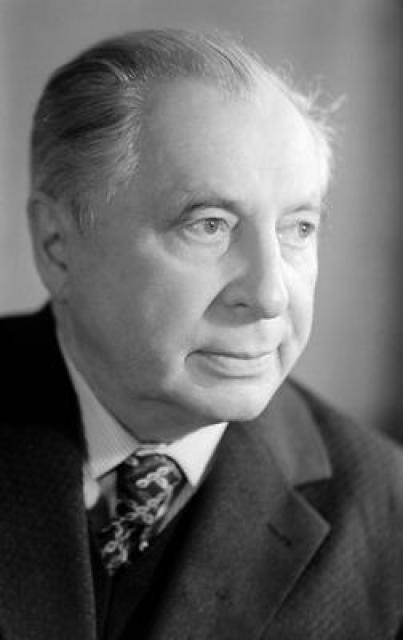
Alexander Zharov
- Early Life and Education
- Political and Literary Engagements
- Poetic Contributions
- Author of the Pioneer Anthem
- World War II and Later Life
- Awards and Recognition
Early Life and Education
Alexander Alexeyevich Zharov was born on March 31 (April 13), 1904, in the village of Semenovskoye, Moscow Governorate, into the family of Alexei Kuzmich Zharov, an artel worker and skilled marble finisher. His father, a decorated veteran of the Russo-Japanese and World War I, participated in the construction of monuments on the Borodino field and the Mausoleum in Red Square.
Zharov attended a rural school in Borodino and studied at a real school in Mozhaisk. In late 1917, he established a cultural and educational circle with his comrades.
Political and Literary Engagements
In 1918, Zharov became a member of the Komsomol (Young Communist League) and served in various leadership positions in Mozhaisk and Moscow. He joined the Russian Communist Party (Bolsheviks) in 1920 and studied at the Faculty of Social Sciences at Moscow State University.
Zharov played a significant role in the development of Komsomol literature as the first editor of the literary and art magazine "Komsomoliya." He was also one of the founders of the Komsomol writer's association "Molodaya Gvardiya" in October 1922.
Poetic Contributions
Zharov's poetry enjoyed widespread popularity among young people from the 1920s to the 1940s. His poem "Garmon," which was highly acclaimed by Mikhail Svetlov, became particularly well-known.
Initial criticism from Vladimir Mayakovsky for employing abstract imagery in his poetry led Zharov to find his niche as a songwriter. He left a lasting mark on Soviet popular music with songs like "Pesnya bylykh pokhodov," "Zavetny Kamen," "Grustnye Ivy," and "Khodili my pokhodami."
Author of the Pioneer Anthem
Zharov's most famous work is the lyrics for the Pioneer anthem "Vzveites' Kostrami, Siniye Nochi," set to music by S.F. Kaidan-Deshkin. The song became an iconic symbol of the youth movement and has been referenced in popular culture, including Mikhail Bulgakov's novel "The Master and Margarita."
World War II and Later Life
During World War II, Zharov served as a correspondent for the magazine "Krasnoflotets." After the war, he continued to write poetry and songs, earning him numerous accolades and awards.
Alexander Alexeyevich Zharov died on September 7, 1984, and is buried in Moscow's Kuntsevo Cemetery.
Awards and Recognition
Zharov received the following awards:Order of the October Revolution
Four Orders of the Red Banner of Labor
Order of the Red Star
Order of the Badge of Honor
Medal for Battle Merit
Medal for the Defense of the Soviet Arctic
Medal for Victory over Germany
Medal for Victory over Japan


