Alfons Rebane
 Germany
- Alfonse Rebane: Estonian and German Military Figure
- Early Career
- Joining the War Effort
- Achievements and Demise
- Life after the War
- Controversial Reburial
Alfonse Rebane: Estonian and German Military Figure
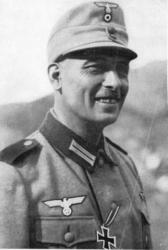
Alfonse Wilhelm Robert Rebane was an Estonian and German military figure. He was born on June 26, 1999 in Tallinn, Estonia. Rebane's remains were reburied at the "Metsakalmistu" cemetery in Tallinn, where distinguished public and political figures of the Estonian Republic are laid to rest. The burial ceremony included military honors, highlighting his status as a "fighter for the freedom and independence of Estonia." Rebane's full name was Alfonse Wilhelm Robert Rebane, and his military service record was impeccable.
Early Career
After graduating from the Military Academy in 1929, Rebane served in various military units, including the 1st armored train regiment, the Laanese Volunteer Division, and the motorized tank regiment. Despite ten years of service, he did not distinguish himself and only reached the rank of senior lieutenant.
Joining the War Effort
Shortly after the establishment of Soviet rule in Estonia, Rebane left military service and never served in the Estonian army again. In May 1941, he organized a group called the "Forest Brothers" with the intention of fighting against Soviet forces. In June 1941, Rebane voluntarily joined the side of the fascists and was appointed as the commander of a separate Estonian security battalion. Although the unit was supposed to operate in Estonia, the Germans redirected them to Russia to guard the rear of the 18th Army. Rebane and his men actively hunted partisans in the Kingiseppa and Kertsovo areas.
Achievements and Demise
In early 1942, Captain Rebane fought against General Vlasov's forces on the Volkhov Front in Russia. In March 1943, his 658th Eastern Battalion, under his command, repelled Soviet attacks. In early 1944, he distinguished himself in battles near Vashkovo, temporarily halting the advance of a Soviet division. For this battle on February 23, Rebane became the first Estonian to be awarded the Knight's Cross.
Later that year, Major Rebane, who had become an SS Obersturmbannführer and the commander of the 45th Estonian SS Division, fought near Narva. In the fall of 1944, his division fought its final battle near Tartu. On September 23, Rebane's unit crossed the Estonian-Latvian border. On May 9, 1945, the division embarked on its final journey westward.
Rebane ended World War II as the acting commander of the 20th SS Division. Interestingly, Admiral Denitz signed the order to award him the Oak Leaves to the Knight's Cross on May 9. However, he did not know that Rebane had surrendered and been taken prisoner. The award only found its recipient in 1975, a year before his death.
Life after the War
After the war, Rebane lived in England and, with the help of the Intelligence Service, organized a resistance network in Estonia against Soviet rule. However, the KGB uncovered these agents and played a game with British intelligence.
After the failed intelligence operations, Rebane was dismissed from British intelligence, and in 1961, he settled in Germany. He passed away on March 8, 1976, in the German city of Augsburg and was buried next to his wife, Agnia.
Controversial Reburial
In Estonia, a black granite monument was erected on Colonel Rebane's grave, with the inscription: "To the Knight of the Knight's Cross with Oak Leaves." The reburial ceremony was attended by representatives of the Republic's authorities, including Lieutenant General Johannes Kert, officials from the Ministry of Defense, officers, and individual parliamentarians. Approximately 400 members of the "Union of Fighters for the Freedom of Estonia," who fought on the side of Germany from 1941 to 1945, also attended the ceremony.
The Estonian government justified the decision to spend 40,000 kroons on the reburial of Rebane by claiming that his grave in Augsburg was abandoned and the German authorities offered to repatriate his remains. The official reason for the reburial was purely humanitarian, without any political motives, according to the government.
However, the decision caused outrage in the global community. Many observers argued that "the cynicism of the action is exacerbated by the fact that, while allocating funds for the reburial of a German soldier, representatives of political forces in Estonia, belonging to the ruling coalition, once again demanded the removal of a monument to soldiers who died in the fight against fascism from the center of the Estonian capital."
Several political parties in Estonia saw the reburial of Rebane as a mockery of the memory of tens of millions of people, including Estonians, who gave their lives in the fight against fascism. They called on all participants of World War II and international organizations to prevent the spread of fascism in the Baltic States and expressed support for protest actions against the fascist tendencies in Latvia, Lithuania, and Estonia.
While Alfonse Rebane may have been a brave individual, he served, with great courage, a regime that promoted hatred and committed crimes against humanity. The canonization of Rebane on the day when Estonia strives to join the EU and NATO undermines the country's reputation. After all, the civilized world unequivocally rejects Nazism and the SS.