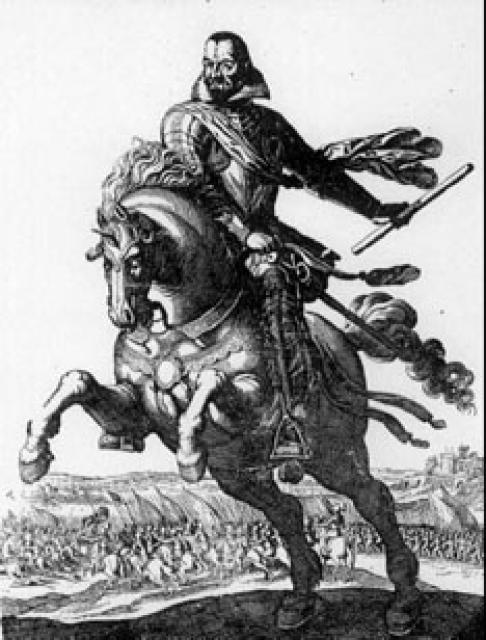
Alibreht Vallenshteyn
- Albrecht von Wallenstein: A Life of Conquest and Tragedy
- The Thirty Years' War and Wallenstein's Supremacy
- Command of the Imperial Army and Downfall
- Return to Command and Assassination
- Legacy
Albrecht von Wallenstein: A Life of Conquest and Tragedy
Early Life and Rise to PowerAlbrecht von Wallenstein was born on September 24, 1583, into a poor but ancient Bohemian noble family. His father's death led him to be placed in a Jesuit school, where he converted to Catholicism, as was customary for many wealthy Bohemian families.
At age 21, Wallenstein began his military career, serving in the Imperial Army during the siege of Gran in Hungary. His bravery and leadership earned him the rank of captain.
In 1609, Wallenstein married the wealthy widow Lucretia Nekšová, who owned a large estate in Moravia. Upon her death five years later, Wallenstein inherited her fortune. This, combined with another inheritance from his uncle, propelled him into the ranks of the wealthy.
In 1617, Wallenstein supported Ferdinand of Styria, who would become the Holy Roman Emperor, in his war against Venice. He raised a cavalry regiment at his own expense and displayed both courage and leadership.
The Thirty Years' War and Wallenstein's Supremacy
The outbreak of the Thirty Years' War in 1618 brought great opportunities for Wallenstein. He formed a cuirassier regiment and assisted in saving the state treasury from Olomouc. His decisive role in the Battle of White Mountain earned him the rank of major general and governorship of Moravia.
During this time, Wallenstein seized the opportunity to engage in astute financial transactions, enriching himself through land confiscations and speculation. By the early 1620s, he had become one of the wealthiest individuals in the Austrian Empire.
In 1623, Wallenstein was elevated to the rank of Imperial Prince and Duke of Friedland, recognizing his military prowess. He constructed a magnificent palace in Prague and established a walled garden that remains a popular tourist attraction today.
Command of the Imperial Army and Downfall
In 1625, Wallenstein raised a 50,000-strong army on his own expense, offering to command it and finance it through contributions from enemy territories. The Emperor accepted, and Wallenstein achieved numerous victories against the Protestant forces.
However, Wallenstein's arrogance and severity drew the ire of Imperial princes and caused unrest among his own troops. In 1630, he was dismissed from his post as commander-in-chief.
Return to Command and Assassination
The Swedish king Gustavus Adolphus's successful campaigns prompted the Emperor to recall Wallenstein. However, Wallenstein insisted on sweeping powers, which were ultimately granted.
Despite some initial victories, Wallenstein faced a decisive defeat at the Battle of Lützen in 1632. Though wounded, he continued to lead until his beloved horse was shot from under him.
In the aftermath of the battle, Wallenstein's enemies convinced the Emperor of his treasonous intentions. In February 1634, his officers assassinated him in the town of Eger (modern-day Cheb).
Legacy
Albrecht von Wallenstein was a complex and controversial figure. His military brilliance and wealth accumulation made him one of the most powerful individuals of his time. However, his arrogance and cruelty ultimately led to his downfall.
He remains an enigmatic and fascinating figure in European history, whose legacy of conquest and tragedy continues to be debated today.