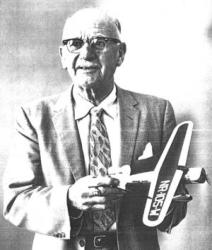
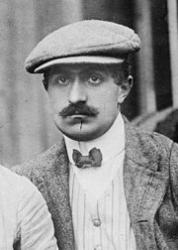
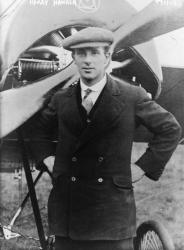
Allan Lockheed
 USA
USABiography of Allan Lockheed
Allan Haines Lockheed, an American aviation pioneer and engineer, was born on January 20, 1889, in Niles, California. He grew up with his half-brother Victor, sister Hope, and brother Malcolm. His mother, Flora, was a successful writer and journalist. After separating from her husband, she moved with her children to Santa Barbara, where her sons experimented with kites. Later, Flora relocated to a fruit farm in Alma, where the boys launched gliders with Professor John J. Montgomery. Despite only completing elementary school, the brothers enthusiastically expanded their knowledge of mechanics from an early age.

In 1906, Allan arrived in San Francisco, where he found work as a mechanic for six dollars a week. By 1909, he had learned to race cars. Meanwhile, his brother Victor, who was in Chicago, convinced the company "Plew" to acquire the rights to one of Montgomery's gliders and purchase a pusher biplane called the "Curtiss." The company hired Allan to convert the biplane into a motorized aircraft. Malcolm and Allan installed a 12-horsepower two-cylinder engine on the Montgomery glider, with Victor assisting as an engineer. Allan made his first flight in Chicago in 1910, taking off in a homemade plane and controlling the ailerons while George Gates, the creator of the aerodynamic control surfaces, operated the elevator and rudder. On his second attempt, Allan successfully lifted the plane off the ground. Reflecting on the experience, he stated, "It was partly nervous, partly confident, and partly damn foolhardy. But I became a pilot from that time on!"
After "Plew" withdrew from aviation due to the crash of two of their planes and the death of a student, Allan became a designer for "International Aeroplane Manufacturing" in Chicago, while also performing aerial stunts for public entertainment. Admission to the air shows cost 25 cents. Recalling this period, Lockheed declared, "In the first week, I cleaned up. I made about $850." During a pleasure flight in Hoopeston, Illinois, his rain-soaked plane failed to gain enough altitude and got entangled in telephone wires. It was at that moment that Allan decided to build an improved aircraft. He returned to San Francisco and worked as an auto mechanic, spending time with Malcolm to develop a three-seat hydroplane despite financial constraints.
Max Mamlock from "Alco Cab" persuaded the brothers to accept $4,000 as an investment in the new "Model G" plane. After 18 months of work, the aircraft, named "ALCO NO. 1," was ready for testing. On July 15, 1913, Allan successfully made the first flight, taking off from the waters of the Golden Gate and reaching a speed of 95 km/h and an altitude of 90 meters. The plane completed three flights that day. The Lockheed model was far ahead of its time, but few were willing to pay ten dollars for a flight on the remarkable machine. Mamlock soon lost interest in aviation and reclaimed "ALCO NO. 1," demanding that Allan and Malcolm pay four thousand dollars to regain possession of the aircraft.
In hopes of obtaining the necessary funds, the Lockheed brothers spent a couple of years in California's "Gold State," engaging in unsuccessful gold mining. In 1915, they finally repurchased the "Model G" with financial support from Paul Meyer. Over five months, Allan took approximately 600 passengers on flights and earned four thousand dollars. One of those who declined the opportunity to experience the incredible feeling of flying was Henry Ford. He stated, "I wouldn't take a straight flight a meter high over the bay in anybody's airplane for all the money in California." In early 1916, the Lockheed brothers moved to Santa Barbara, where they received numerous requests from people eager to take their first flight. Additionally, Allan transported individuals to coastal islands and earned money from filmmakers who wanted aerial footage.
After establishing the "Loughead Aircraft" company, the Lockheed brothers introduced the revolutionary single-seat S-1 sport biplane by 1919. Following successful trials, Gilbert Budwig hailed the S-1 as the "most flyable airplane." Thousands of people marveled at the new creation at the aviation exhibition in San Francisco, but none ordered the two-thousand-five-hundred-dollar biplane. The "Loughead Aircraft" company closed in 1920.
In 1922, Allan became a real estate salesman in the Hollywood area. Although he was not particularly fond of his job, he was satisfied with his financial situation. In December 1926, Lockheed, along with Jack Northrop, Kenneth Jay, and Fred Keeler, founded the aircraft manufacturing corporation "Lockheed Aircraft." Allan assumed the position of Vice President and General Manager.
Developing one of the company's most successful projects, the high-speed monoplane "Vega," costing $17,500, proved to have an economic cruising speed of nearly 300 km/h and could accommodate six people. After test pilot Eddie Bellande safely landed the monoplane, he exclaimed, "Boys, this is it! Flying becomes a real pleasure!"
Following the successful aviation expeditions of George Hubert Wilkins to the Arctic and Antarctica using the "Vega," the "Lockheed Aircraft" corporation received numerous new orders. By 1928, sales surpassed the one million dollar mark. In 1937, Lockheed opened the "Alcor Aircraft" corporation, which lasted until 1939. After World War II, he returned to his real estate sales duties while occasionally providing aviation consultations.
Allan died of liver cancer in Tucson on May 26, 1969, at the age of 80.