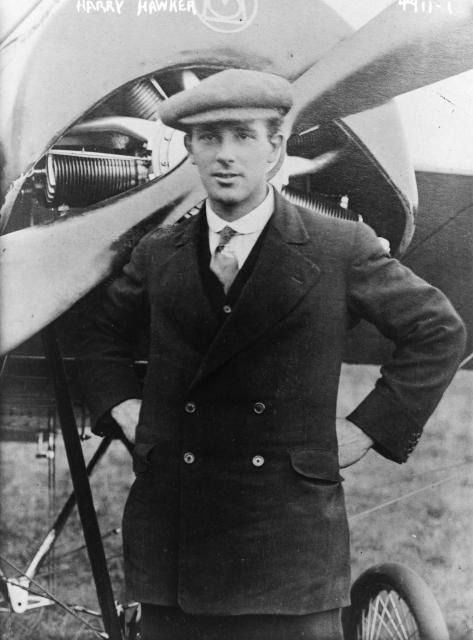
Harry Hawker
 Australia
- Harry Hawker: An Australian Aviation Pioneer
- Early Life and Career
- Contributions to Aviation
- Tragic Accident and Legacy
Harry Hawker: An Australian Aviation Pioneer
Harry George Hawker, born on January 22, 1889, in Moorabbin, Victoria, Australia, was an Australian aviation pioneer who played a significant role in the development of aircraft during his career. As the chief test pilot for Sopwith, he participated in the design and testing of numerous aircraft for the company. Hawker's life took a dramatic turn when he made a forced landing on water during one of his flights and was rescued by the Danish ship, Danish Mary. After World War I, he went on to establish Hawker Aircraft Company.

Early Life and Career
At the age of 11, Harry Hawker began assisting in the production of engines in a garage in Melbourne for a weekly wage of 5 shillings. He later joined Tarrant Motor & Engineering Co, where he was involved in the construction of Australia's first automobile with a gasoline engine, the Tarrant car. In 1907, Hawker became a chauffeur and mechanic in Western Victoria. In 1910, he witnessed the first demonstration of manned flight in Australia, which sparked his passion for aviation.
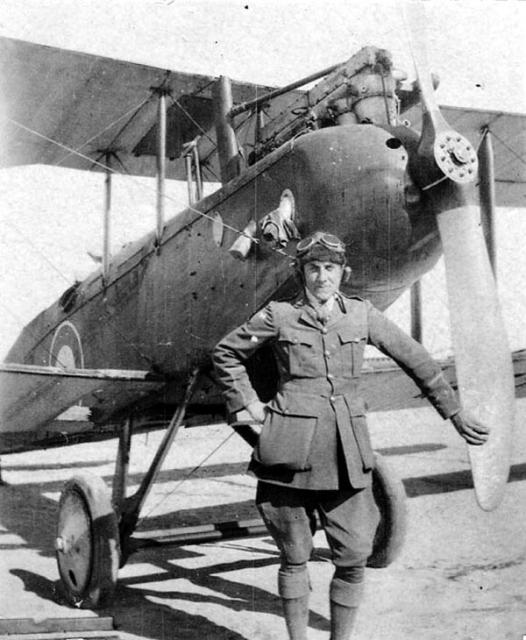
Relocating to England in 1911, Hawker secured a job at Commer Car Company before moving on to Mercedes and Austro Daimler. Alongside his work, Hawker spent a significant amount of time at Brooklands Aerodrome, the center of British aviation at the time. In June 1912, he finally found employment as a mechanic at Sopwith Aviation Company. Hawker convinced the staff at Sopwith to teach him how to fly, and after just three lessons, he took to the skies solo. He obtained his pilot's license in September 1912 and won the Michelin Trophy a month later for the duration of his flight, which lasted 8 hours and 23 minutes.
Contributions to Aviation
Harry Hawker quickly became the chief test pilot for Tom Sopwith and played a vital role in the development and improvement of the Sopwith Tabloid, a small biplane. In 1914, he returned to Australia to showcase the advanced British aircraft, originally designed for sport, but later adapted for military use. Hawker was also involved in the development of the Sopwith Tabloid.
During World War I, Hawker continued to test and refine the Sopwith Tabloid. Following the war, he embarked on an ambitious venture with navigator Kenneth Mackenzie Grieve to win a £10,000 prize from the Daily Mail. The challenge was to cross the Atlantic without stopping within 72 hours. On May 18, 1919, they took off from Mount Pearl, Newfoundland, in the experimental Sopwith Atlantic biplane. However, after 14.5 hours of flight, the engine overheated, and Hawker and Grieve were forced to make an emergency landing at sea. They were eventually rescued by the passing cargo ship, Danish Mary. Due to the lack of a functioning radio receiver on board, it took Hawker six days to report their location when the ship arrived in Scotland. The aviators received a consolation prize of £5,000 from the newspaper. In honor of the ship that saved them, Hawker named his second daughter Mary.
Tragic Accident and Legacy
On July 12, 1921, Harry Hawker piloted the British Nieuport Goshawk fighter plane, which crashed at Hendon Aerodrome. According to medical reports, Hawker suffered a mid-air hemorrhage, which led to his unsuccessful attempt to land the aircraft. The crash, combined with Hawker's spinal tuberculosis and a fire in the plane, resulted in his death.
In 1989, Moorabbin Airport in Australia was renamed Harry Hawker Airport in honor of the legendary aviation pioneer.