Alvarets Godoy
 France
- Manuel de Godoy: A Rise to Power and a Fall from Grace
- Chief Minister of Spain
- The "Prince of Peace"
- Economic Power and Corruption
- Return to Power and the Peninsular War
- Downfall and Exile
- Partial Rehabilitation and Legacy
Manuel de Godoy: A Rise to Power and a Fall from Grace
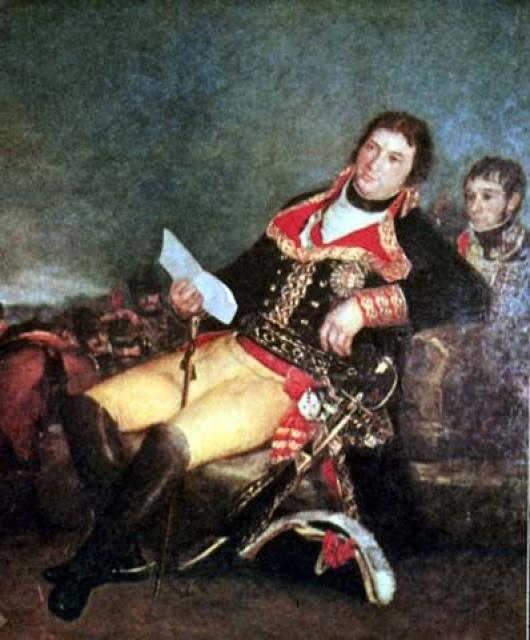
Early Life and Rise to ProminenceManuel de Godoy was born into a poor noble family and began his military career in the Royal Guard in 1784. His striking appearance caught the eye of Infanta Maria Luisa, who became his lover and confidante. When her husband ascended to the throne as King Charles IV in 1788, Godoy's fortunes skyrocketed. He became a general-adjutant in the Royal Guard and Minister of Foreign Affairs in 1792.
Chief Minister of Spain
Upon the fall of the Aranda Cabinet in 1792, Godoy became Prime Minister of Spain. He played a crucial role in saving the French royal family from execution during the French Revolution. However, his alliance with the anti-French coalition led to war with France, culminating in Spain's defeat in the War of the Pyrenees (1793-1795).
The "Prince of Peace"
In the aftermath of the war, Godoy negotiated the Treaty of Basel (1795) with France, earning him the nickname "the Prince of Peace." This treaty ceded Santo Domingo to France and marked the beginning of a close alliance between the two nations. In 1796, Godoy signed a military alliance with France, which drew Spain into a new war against Great Britain.
Economic Power and Corruption
Godoy became one of the wealthiest men in Spain, with assets exceeding the nation's annual budget. He faced accusations of corruption and nepotism, which earned him widespread disdain. In 1798, he was forced to resign under pressure from the opposition.
Return to Power and the Peninsular War
Godoy regained his position in the government in 1801 and became commander-in-chief of the Spanish forces. He led a successful campaign in Portugal, but Spain remained vulnerable to British attacks. In 1804, he declared war on Great Britain.
The Battle of Trafalgar in 1805 proved disastrous for the Spanish navy. Godoy sought an alliance with France and concluded a secret treaty in Fontainebleau in 1807. However, Napoleon used Godoy's unpopularity to his advantage, igniting an uprising in 1808.
Downfall and Exile
Godoy fled Spain and was arrested in 1808. His property was confiscated, and he was imprisoned. After Charles IV abdicated, Godoy was released by the French and lived in exile in Rome. He eventually settled in Paris and received a small pension.
Partial Rehabilitation and Legacy
In 1847, some of Godoy's property and titles were restored, and he was allowed to return to Spain. He died in 1851. While his career was marked by successes and failures, Godoy remains a controversial figure in Spanish history, accused of corruption and treachery. His alliance with France during the Peninsular War is often seen as a betrayal of his country.