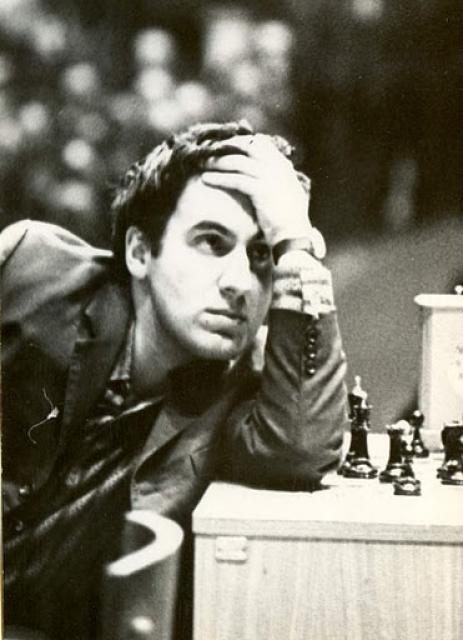
Alvis Vitolins
 Latvia
- Alvis Vītoliņš: A Latvian Chess Legend
- Ascendancy and Achievements
- Maverick Style and Contributions
- Influence and Legacy
- Personal Struggles and Tragic End
Alvis Vītoliņš: A Latvian Chess Legend
Childhood and Early CareerBorn in the picturesque town of Sigulda, Alvis Vītoliņš was introduced to the world of chess by his father, a skilled player. His natural reserve made him gravitate towards the game, avoiding the rowdy pastimes of his peers. At the age of six, he began his chess journey.
Ascendancy and Achievements
In 1959, Vītoliņš became a first-category player. At just 15, he triumphed at the All-Union School Children's Spartakiad in Baku, securing first place on the top board. A year later, his performance in the USSR Championship semi-finals earned him the title of Master.
In 1963, Vītoliņš shared first place with Alexander Zakharov in the All-Union School Children's Tournament. Despite qualifying for the World Youth Championship, he was not sent to the event. Undeterred, he continued to excel in republican competitions for masters.
Maverick Style and Contributions
Vītoliņš possessed a unique and aggressive playing style. "I don't know how to play for a draw," he famously declared. "Always for the win. That's why I often lose." His daring sacrifices and audacious long-range strategies became a hallmark of his chess.
He was an avid admirer of Alexander Alekhine and his contemporary, the great Mikhail Tal. Vītoliņš's personal encounters with Tal resulted in one defeat and three draws, an impressive record considering Tal's prowess.
Vītoliņš made valuable contributions to opening theory, developing a modern approach to Cochrane's Attack in the Russian Game (Petrov's Defense) with 1. e4 e5 2. Nf3 Nf6 3. Ne5 d6 4. Nf7?!. He also introduced the Vitolins Variation in the Sicilian Defense: 1. e4 c5 2. Nf3 d6 3. d4 cxd4 4. Nxd4 Nf6 5. Nc3 e6 6. Bb5+.
Influence and Legacy
Vītoliņš's presence motivated and inspired a generation of Latvian chess players. Among those who benefited from his guidance was Alexei Shirov, who initially lost to Vītoliņš but went on to become a renowned grandmaster.
His influence extended beyond the Latvian borders. Vītoliņš's friendship with Tal, his collaboration in preparing for important events, and his own success helped popularize chess in the Soviet Union.
Personal Struggles and Tragic End
Despite his achievements, Vītoliņš faced personal difficulties. He had difficulty with psychological balance and emotional control, which journalist and coach E. Gurevich attributed to a lack of discipline and an unfavorable lifestyle.
On February 16, 1997, Vītoliņš took his own life by jumping from a railway bridge into the icy waters of the Gauja River. His legacy lives on in the tournaments and variations that bear his name and in the countless young chess players he inspired.


