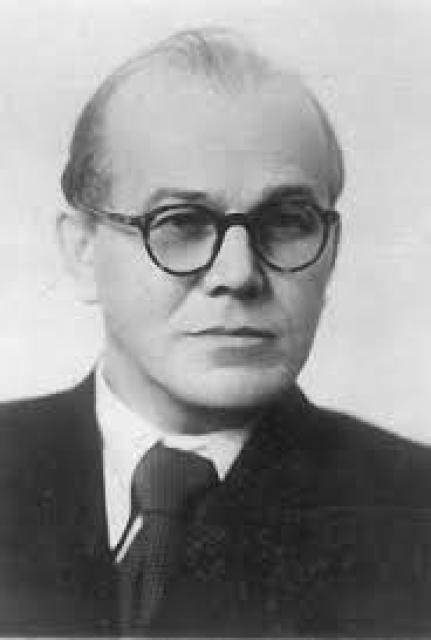
Anatoliy Betehtin
- Early Life and Education
- Academic Career
- Contributions during World War II
- Leadership and Research
- Editorial Roles and Publications
- Awards and Honors
- - Chairman of the Special Scientific Council
Early Life and Education
Nikolai Petrovich Shenkmanwas born on February 24 (March 8), 1897, in the village of Strigino, Вологодская губерния, Russia. The son of a clerk, he graduated from the Noshuli Primary School in 1910 and entered the Usty-Sysolsk School, which he graduated from with a gold medal in May 1917. In 1924, Shenkman earned a degree from the Leningrad Mining Institute.
Academic Career
After completing his studies, Shenkman became a lecturer in 1929 and a professor in 1937. He played a significant role in the development of mineralogy and the study of ore deposits and mineralogy. As a student and colleague of V. I. Vernadsky and A. N. Zavaritsky, Shenkman was influential in the field. From 1937 onward, he worked at the Institute of Geological Sciences of the Academy of Sciences of the USSR in Moscow.
Contributions during World War II
During World War II, Shenkman worked with the Commission for Mobilization of the Country's Raw Materials Resources for Defense. He supervised geological exploration for manganese добыча and was involved in an expedition to the Kazakh SSR. On December 4, 1946, he was elected a Corresponding Member of the Academy of Sciences of the USSR in the Department of Geological and Geographical Sciences.
Leadership and Research
On October 23, 1953, Shenkman became an Academician of the Academy of Sciences of the USSR in the Department of Geological and Geographical Sciences, specializing in mineralogy and ore deposits. From 1953 to 1955, he headed the Department of Ore Deposits at the Institute of Geological Sciences of the Academy of Sciences of the USSR, while also serving as head of the Minerographic Laboratory at the institute.
In 1956, Shenkman joined the Institute of Geology of Ore Deposits, Petrography, Mineralogy, and Geochemistry of the Academy of Sciences of the USSR as head of the Minerographic Laboratory. He established the scientific discipline of mineragraphy (the study of ores under a microscope in reflected light) in the Soviet Union.
Shenkman's research focused on the study of ore structures and mineral paragenesis based on the principles of physical chemistry and crystal chemistry. He identified systematic facial changes in manganese-bearing sediments and developed a theory on the formation of manganese ores.
Editorial Roles and Publications
Shenkman served as the editor-in-chief of the journal "Geology of Ore Deposits" (1958) and a member of the editorial boards of the journals "Proceedings of the Academy of Sciences of the USSR" (1954) and "Soviet Geology".
His notable publications include "Basic Problems in the Study of Magmatogenic Ore Deposits" (1953), for which he was awarded the Lenin Prize in 1958.
Awards and Honors
Awards and honors bestowed upon Shenkman include- Order of the Red Banner of Labor (1945)
- Stalin Prize, 2nd Degree (1947)
- Order of Lenin (1953)
- Order of the Red Banner of Labor (1957)
- Lenin Prize (1958)
- Gold Medal named after A. P. Karpinsky (1961)
Organizational Affiliations
Shenkman held various leadership positions in professional organizations, including:
- Member of the Bureau of the Department of Geological and Geographical Sciences of the Academy of Sciences of the USSR
- Chairman of the Special Scientific Council
- Deputy Chairman of the Special Higher Certification Commission- Member of the State Commission on Reserves
- Vice President of the All-Union Mineralogical Society (1960)
- Honorary Member of the Urals Geological Society
- Member of the German Academy of Natural Scientists "Leopoldina"
Death and Legacy
Nikolai Petrovich Shenkman passed away on April 20, 1962, from a heart attack. He was buried in the Novodevichy Cemetery in Moscow. His contributions to mineralogy, ore deposit studies, and other fields of geology have left a lasting impact on the scientific community.


