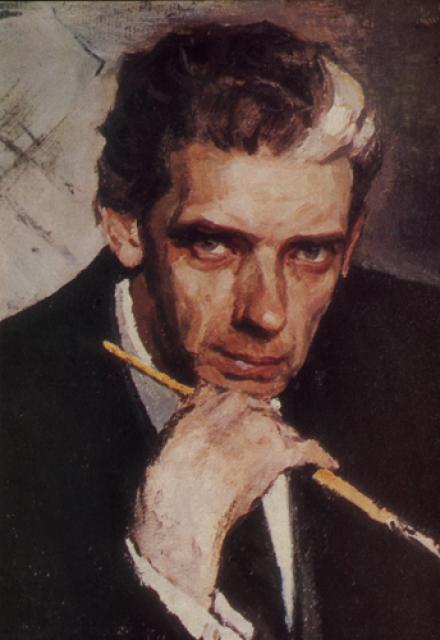
Anatoliy Nasedkin
 Ukraine
Anatoliy Nasedkin: A Biography
Anatoliy Leonidovich Nasedkin was born on April 22, 1924, in Veliky Novgorod, Russia. He grew up in a family of four children, with his parents Leonid Efimovich and Nina Petrovna Nasedkin. From a young age, Nasedkin developed a love for his native nature, the green meadows, birch groves, and winding shores of Lake Ilmen and the Severny Donets River.
Nasedkin's artistic roots can be traced back to both Russian and Ukrainian cultures, which he believed should not be separated by national borders. His paternal grandfather, Petr Vasilievich Kostsov, played a significant role in shaping Nasedkin's personality. Despite coming from a merchant family and lacking a higher education, Petr Vasilievich was known throughout the city for his mechanical and locksmith skills. He had a rich home library and aimed to instill a love for literature and knowledge in his children and grandchildren. It was in his grandfather's library that young Anatoliy first discovered his passion for drawing, copying pictures from books.
As a child, Nasedkin developed a love for the ancient city of Veliky Novgorod, where he lived until the age of six before relocating to Kharkiv, Ukraine. He attended a boys' gymnasium, where he was most drawn to humanities subjects such as history and literature. His admiration for the works of Maxim Gorky, Taras Shevchenko, Hryhoriy Skovoroda, and Ivan Franko would later manifest in a series of paintings, engravings, and lithographs dedicated to these great literary figures.
Nasedkin's love for art grew as he spent countless hours at the Kharkiv Art Museum. He would wander through its halls, captivated by the works of Karl Bryullov, Ivan Aivazovsky, Ivan Shishkin, Ivan Kramskoy, and other prominent artists. The addition of Ilya Repin's famous paintings, "Zaporozhian Cossacks Writing a Letter to the Turkish Sultan" and "Cossack in the Steppe," to the museum's collection in the early 1930s became some of Nasedkin's favorite pieces. He considered himself a follower of Repin and Dmitry Stasov, two influential figures in Russian classical painting.
At the age of twelve, Nasedkin joined an art studio at the newly opened Pioneers' Palace. He would walk twice a week, crossing the entire city from Kharkiv's Holodna Hora, to attend the studio. It was here that he received his first formal education in drawing. The Pioneers' Palace studio held exhibitions for all significant events and anniversaries. One such exhibition honored the heroic Papanin expedition, the first Soviet people to conquer the North Pole. The legendary polar explorers, Ivan Papanin and Ernst Krenkel, visited the Pioneers' Palace. Inspired by their presence, Nasedkin created a drawing called "Papanintsy," which was published in the collection "Shchaslyva Yunist" in 1938. The drawing then participated in an exhibition at VDNKh in Moscow, where Nasedkin received an award from the exhibition committee. This recognition marked his first acknowledgment as an artist, albeit at a young age.
Tragedy struck Nasedkin's family when his father passed away in 1941. The responsibility of raising the children fell on his mother, Nina Petrovna, who worked as a seamstress from home. Anatoliy had just finished his ninth grade, and his drawings were already being recognized by well-known artists in Kharkiv. It was the year 1941, and World War II had begun. Anatoliy's older brother, Valentin, was sent to the front and was later reported missing in action.
In 1943, when Kharkiv was liberated, Anatoliy Nasedkin voluntarily joined the army. He became an infantryman and fought on the Oryol-Kursk direction. During one of the battles near a small village in Bryansk Oblast, Anatoliy was severely wounded. He spent months in various hospitals in Tula, Moscow, and Sverdlovsk before finally returning to life in 1945. Among his many medals and awards, the most treasured for Nasedkin was the "For Valor" medal, which he received for the battle in which he was severely wounded. Back in Kharkiv, Nasedkin continued to develop his painting skills. In 1946, he entered the Kharkiv Art Institute, where he studied under Mykhailo Derehus and Yevhen Svetlychnyi. Here, he became a professional artist.
In 1957, Anatoliy Nasedkin met Irina Igorovna Tikhova, and they got married in 1958. They welcomed their daughter, Viktoriya, in 1961. Irina gave up her career to support her husband and family.
Nasedkin's early artistic career was deeply influenced by Maxim Gorky. He immersed himself in Gorky's works, exploring the places the writer had visited and painting numerous studies and sketches. This passion for Gorky led to a series of paintings, engravings, and lithographs dedicated to the writer and his works. However, Nasedkin's greatest love was for drawing. He would draw every spare minute, even skipping classes to sketch in the forest or by the river.
Another passion of Nasedkin's was portraiture. He had a vast collection of portraits ranging from peasants and workers to students and friends. Among his most cherished portraits were those of his family members, which formed a sort of genealogy, telling the story of his ancestors for future generations.
In 1976, Nasedkin held a retrospective exhibition in Kharkiv and later in Kyiv, showcasing his diverse body of work since his graduation from the Kharkiv Art Institute. The exhibition featured finished works, as well as sketches, drawings, autolithographs, and illustrations.
Throughout the 1970s and until his death, Nasedkin became fascinated with still life and landscapes. He aimed to capture the freshness and beauty of freshly picked wildflower bouquets, fleeting moments in nature, and the dynamic movements, colors, and compositions that characterized the contemporary spirit. His landscapes, such as "The Road to Shatilovka" (1958), "Construction of the 'Pioneer' Swimming Pool" (1970), "First Snow" (1971), "View of Lenina Street" (1981), and "View of Kolomenskaya Street" (1982), captured the history of Kharkiv's streets where he lived.
In the early 1990s, Nasedkin returned to his Shevchenko-themed works, creating large-scale paintings, sketches, and studies dedicated to the famous Ukrainian poet and artist Taras Shevchenko. His works gained recognition internationally, and exhibitions featuring his paintings were held in England, France, and Japan.
On July 26, 1994, Anatoliy Leonidovich Nasedkin passed away, leaving behind a remarkable legacy. He was honored as a People's Artist of Ukraine and a Merited Artist. In 1985, he received the State Taras Shevchenko Prize, Ukraine's highest artistic honor. Nasedkin's dedication to his craft and his passion for capturing the beauty of his surroundings through his paintings have made him one of the most respected artists of the Kharkiv Art School.