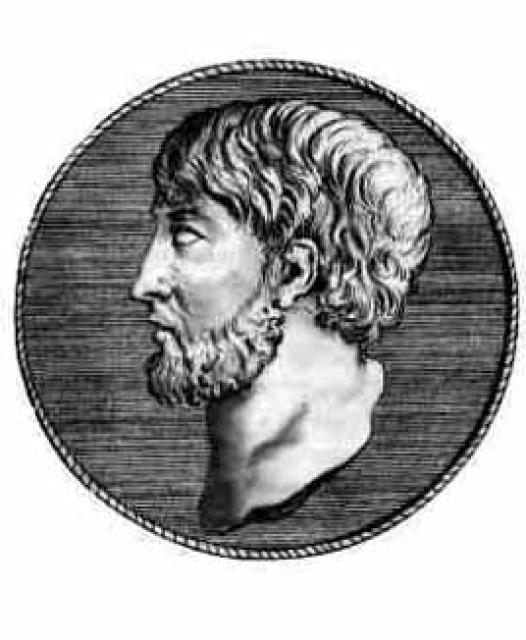
Anaximenes
 Greece
- Anaximenes: The Last of the Milesian School
- Air as the Ultimate Source
- Air's Dual Nature
- Cosmogony of Air
- The Micro- and Macrocosm
- Cosmic Origins: Matter and Spirit
- Scientific Interests
- Meteorology
- Astronomy
- Legacy and Style
Anaximenes: The Last of the Milesian School
Anaximenes was an ancient Greek philosopher, the last representative of the Milesian school of natural philosophy. He was the student of Anaximander and continued the trend of elemental materialism, seeking natural causes for phenomena and things.
Air as the Ultimate Source
Like Thales and Anaximander before him, Anaximenes believed that the underlying substance of the world was a特定 type of matter. This substance was an infinite, boundless, and formless air from which everything else originated. "Anaximenes... proclaims the air as the origin of all that is, for from it everything comes into being and to it everything returns."
Anaximenes materialized the apeiron, the abstract concept defined by his teacher. He described the properties of the cosmic origin by borrowing the qualities of air. He used Anaximander's substantial term, but attributed it to air. Like Anaximander's apeiron, Anaximenes' air was boundless. However, he understood the origin in conjunction with other air-like properties. Consequently, the static and dynamic aspects of the origin were determined by these additional qualities.
Air's Dual Nature
Anaximenes' air satisfied both the ideas of Thales (an abstract origin conceptualized as a concrete natural element) and Anaximander (an abstract origin understood as such, without qualities). Air was the most formless of all material elements, a transparent and invisible substance difficult to see, colorless and lacking ordinary physical qualities. Yet, it was also a qualitative origin, embodying generalized, abstract, and universal content.
Cosmogony of Air
According to Anaximenes, the world emerged from the "boundless" air, and the diversity of things represented air in various states. Through rarefaction (heating), air transformed into fire, while condensation (cooling) produced wind, clouds, water, earth, and rocks. Rarefied air created heavenly bodies with fiery characteristics. A crucial aspect of Anaximenes' theory was the understanding of condensation and rarefaction as fundamental, opposing yet equally functional processes involved in the formation of different states of matter.
The Micro- and Macrocosm
Anaximenes' choice of air as the cosmogonic first principle and the actual lifeblood of the cosmos was based on the principle of parallelism between the microcosm and macrocosm: "just as the air in the form of our soul holds us together, so breath and air encompass the entire Earth." The boundless air enveloped the entire world, acting as the source of life and breath for living beings.
Cosmic Origins: Matter and Spirit
In completing his unified view of the cosmos, Anaximenes found in the boundless air the origin of both body and soul. The gods also originated from air. The soul was airy, and life was breath. Augustine noted that "Anaximenes did not deny the gods or pass them over in silence... Anaximenes... said that the origin is boundless air, and that from it arises everything that is, was, and will be; [all] divine and heavenly things; and that all that will come after will arise from the offspring of air." However, Augustine also reported that Anaximenes was convinced that "the gods were not created by air, but that they themselves were from air." Thus, for Anaximenes, the gods were modifications of the material substance and, according to orthodox theology, non-divine.
Scientific Interests
Anaximenes' scientific interests were narrower than those of his predecessors, focusing primarily on meteorology and astronomy.
Meteorology
As a meteorologist, Anaximenes believed that hail formed when water falling from clouds froze; if air mingled with the freezing water, snow would form. Wind was condensed air, and weather conditions were linked to the Sun's activity.
Astronomy
Like Thales and Anaximander, Anaximenes studied astronomical phenomena, aiming to provide natural explanations. He believed the Sun was a [flat celestial] body similar to the Earth and Moon, heated by its rapid motion. The Earth and celestial bodies floated in the air, with the Earth being stationary and the other celestial bodies and planets (which Anaximenes distinguished from stars and believed arose from Earth's vapors) moving through cosmic winds.
Legacy and Style
Anaximenes' writings are only partially preserved. Unlike his teacher Anaximander, who wrote in what the ancients described as "ornate prose," Anaximenes wrote in a simple and straightforward style. In expounding his teachings, he often employed imaginative comparisons. He likened the condensation of air, which "produced" the flat Earth, to "the rolling of wool," and the Sun and Moon to fiery leaves floating in the air.




