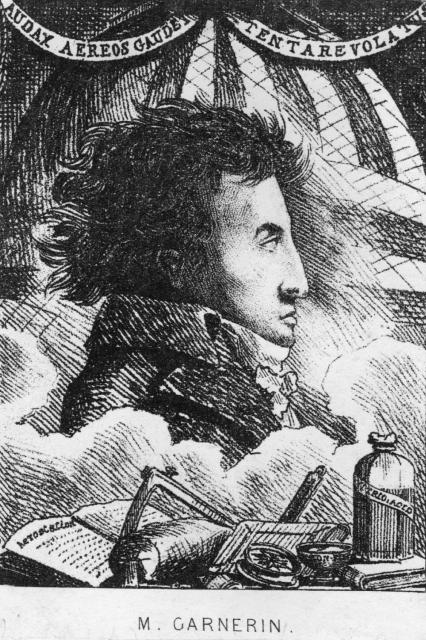
Andre-Jac Garneren
 France
Biography of André-Jacques Garnerin
André-Jacques Garnerin (1769 - 18.08.1823) was a French aeronaut and the first parachutist. In 1793, he became an inspector for the French army, pioneering the use of balloons for military purposes. During the fighting, he was captured by the English and spent two years as a prisoner. Upon his return to France, he began performing high-altitude flights in a hot air balloon and in 1797, he made a parachute jump from a height of 1000 meters. Continuing his demonstration flights across European cities, he set a record in 1802 in England with a jump from a height of 2440 meters. His parachute, made of white silk and shaped like an umbrella, had a diameter of about 7 meters.
Leonardo da Vinci once wrote, "If a piece of fabric is taken and sewn into the shape of a pyramid, with each side measuring 12 cubits in width and height, it will be possible to descend from any height." Considering that the medieval unit of length, the cubit, ranged from 50 to 60 centimeters in different countries, such a device indeed provided a safe descent from any height, as the diameter of modern parachutes also does not exceed 6-7 meters. However, as later discovered, Leonardo da Vinci was not the first to come up with the idea of a parachute. By the way, the word "parachute" is derived from the combination of two words: the Italian "para," meaning to prevent, and the French "chute," meaning fall. Preventing a fall. It couldn't be said more accurately.
The Early Attempts
Ancient records indicate that people in many countries attempted to descend from towers, trees, and cliffs using various contraptions resembling umbrellas. Often, such jumps ended in injury or even death because no one understood the laws of air resistance, and intuition often failed. Leonardo da Vinci was the first to point out the most advantageous dimensions for a parachute, and this was later remembered by balloonists. Already disappointed by the tragic death of Pilâtre de Rozier, Jean-Pierre Blanchard began experimenting with the parachute. At first, he attached small parachutes underneath the basket and descended from a height with various animals, such as dogs and cats, to entertain the public. They descended to the ground unharmed. This meant that if a parachute of suitable size was made, a person could safely descend from a height in the event of a balloon accident. But what to do with the large parachute - the dome, the straps, and belts, or the suspension system, if the balloon cabin was small, cramped, and often too narrow to turn around?
André-Jacques Garnerin's Solution
The French aeronaut André-Jacques Garnerin, who became interested in parachutes even before Blanchard, solved this problem very simply. He attached a large umbrella-like parachute to the balloon and then attached the parachute straps to the basket. On October 22, 1797, Garnerin ascended in Paris in such a balloon. Reaching a height of one kilometer, he cut the rope connecting the parachute to the balloon. The spectators watching the flight gasped in fear as they saw the basket with the aeronaut detach and fall, while the hydrogen-filled balloon quickly disappeared into the clouds. But then the straps tightened, and Garnerin began a smooth descent in the basket under the dome of the huge umbrella.
André-Jacques Garnerin, together with his brother, began traveling to cities in Europe, performing daring parachute descents for money. Over time, Garnerin's wife Geneviève and his daughter Eliza joined them, becoming the world's first female parachutists.
However, the early experiments with the umbrella-like parachute showed that its structure and attachment were ineffective. The umbrella obstructed the balloon and hindered its control. Then they tried attaching the parachute dome and straps underneath the basket. This was slightly better, but still not very convenient. The parachutist had to jump out of the basket, the rope would break, and the dome would fill with air during the descent, bringing the daredevil safely to the ground. Parachute jumps still make an irresistible impression on spectators, even more so in those times. Many wandering parachutist-aeronauts emerged, showcasing parachute jumps in various countries. By the way, André-Jacques Garnerin was one of the first aviators to demonstrate balloon flights in Russia in 1803.
There were also many parachute enthusiasts in Russia itself. The newspaper "Moskovskie Vedomosti" for the year 1806 reported that Russian aeronaut Aleksandrovsky ascended into the air in a large balloon and made a parachute jump. The brave parachutist descended safely to the ground and was enthusiastically greeted by the spectators. After Aleksandrovsky, numerous sportsmen-parachutists, or as they were called at that time, acrobats, emerged. They performed at fairs, public festivities, and in parks. During their descent, the acrobats performed mind-boggling tricks on a trapeze.
By the end of the century, a whole family of sportsmen-parachutists gained the most popularity in Russia - Józef and Stanisław Drevnitski and their sister Olga. Born in Warsaw, the brothers became interested in parachute jumps not by chance. In 1891, they started with flights in a hot air balloon, but soon realized that balloon flights were risky. So, for aeronauts who had a parachute on board, there was a better chance of survival than for those who disregarded the parachute.
Józef and Stanisław constructed a suspended parachute similar to those used by Garnerin and began testing it. They ascended to a height of one kilometer, and Józef Drevnitski jumped out of the basket. The parachute, hanging from a thin rope attached to the basket, held on until it was jerked apart. Under the weight of the parachutist, the dome rushed downward, but immediately filled with air, and Józef Drevnitski descended smoothly to the ground. Not far away, his brother Stanisław descended on a balloon as well.
The first jump made such a huge impression on Józef Drevnitski that he decided to repeat it. Following his brother, Stanisław also became enthusiastic about parachute jumps. Over three years, the Drevnitski brothers made dozens of jumps and perfected their technique, as well as improved the parachute itself, without experiencing any serious accidents. Watching the flights and daring jumps of the brothers, their younger sister Olga also decided to engage in this unusual activity for women of that time. In 1896, she made her first parachute jump and immediately became an avid fan of this daring sport.
However, it was Józef Drevnitski, the eldest brother, who contributed the most to the popularity of parachuting in Russia. On July 23, 1910, he made a demonstration jump in St. Petersburg. Thousands of people came to see the renowned "jumper." They laid out the shell of a large balloon on the platform in Krestovsky Park. When the balloon was filled with hot air, it was barely held by thirty workers. Underneath the basket, they suspended the partially unfolded parachute. At Józef Drevnitski's command, the workers released the balloon, and it quickly rose to a height of 200 meters. Then, Drevnitski calmly detached himself from the basket, and before the crowd could gasp, the parachute opened and, like a huge umbrella, gently descended the brave parachutist to the ground, where the audience gave him a standing ovation.
The interest in parachutes was so great that Drevnitski had to make more than a dozen jumps in St. Petersburg alone, totaling over four hundred jumps throughout his career without sustaining any injuries. This convinced many that the idea of a parachute was valid and simply required refinement. The cumbersome and inconvenient nature of parachutes made many balloonists prefer to fly without them. It took many years before the Russian inventor Gleb Kotelnikov managed to create a convenient design for a backpack parachute that was reliable and easy to use.
In the meantime, brave and daring aeronauts-parachutists continued to amaze thousands of people gathered to witness this extraordinary spectacle. Parachutes were uncontrollable and descended wherever they pleased. Parachutists were often blown onto houses, trees, or the steeples of churches. Sometimes, these stunts ended tragically, with parachutists crashing or sustaining injuries upon impact with obstacles. So, in its essence, Leonardo da Vinci's accurate idea was realized only 400 years later. What can you do: in aviation, each new step, each invention, was achieved with great difficulty.


