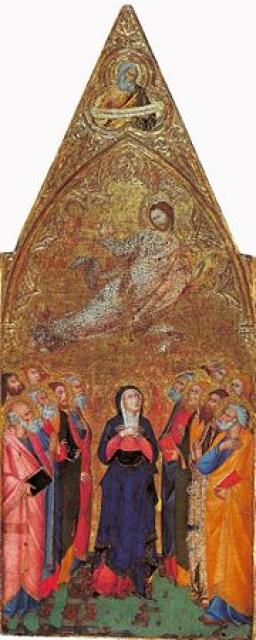
Andrea Vanny
 Italy
ItalyBiography of Andrea Vanni
Andrea Vanni was an Italian artist associated with the Sienese School. However, his significance lies more in his political and diplomatic activities, making him a figure of historical interest rather than artistic. It is believed that he became involved in politics after the democratic Council of Twelve was overthrown in Siena.
Political Activism and Diplomacy
In 1368, during a period of political instability in the Republic of Siena, Andrea actively participated in a rebellion against the ruling nobles. As a result, they were expelled, and the Council of Twelve was reinstated, with Andrea Vanni as a member. According to church sources, he took part in the uprising alongside Bartolo, the brother of St. Catherine of Siena, with whom Andrea had a long-standing friendship. He was a devoted admirer of St. Catherine and even received letters from her, some of which have been preserved. There is a fresco attributed to Andrea at the Sienese church of San Domenico, depicting St. Catherine of Siena, which is considered the only contemporary portrait of the saint, although there are some scholars who dispute this claim.
After becoming a member of the governing council, Andrea Vanni was entrusted with various state affairs. He was given the responsibility of diplomatic missions to the papal courts in Naples and Avignon, which were highly significant tasks. However, his semi-literate letters that have survived to this day have raised doubts among some researchers about his diplomatic abilities. Nonetheless, throughout his long life, Andrea held several different governmental positions and undertook diplomatic missions to Rome and Florence, in addition to Naples and Avignon. Andrea Vanni passed away around 1414. The absence of a record of his death in the Sienese church of San Domenico, where his entire family rests, gave rise to the theory that he died somewhere abroad.
Artistic Career
Andrea Vanni's artistic output is relatively small, likely due to his dedication to state affairs. His artistic period spanned over sixty years, but most of his works are not precisely dated, making it difficult to reconstruct his artistic development. His main characteristic is that, having been influenced by the art of the early 14th century, particularly the works of Simone Martini and the Lorenzetti brothers, Andrea maintained those ideas throughout his life. Even fifty years later, he painted "Madonnas with Child" in the same style as at the beginning of his career. His major works are concentrated in Siena, although records indicate that he lived in Naples in 1383-84, so some of his works are located there.
Artistic Style
His early small-scale "Madonnas with Child" (Oxford, Ashmolean Museum; Berlin, Art Gallery) feature soft contours and gentle tonal shades, reflecting his light brushwork. However, the depiction of the child on these paintings appears stiff, connecting his early works with his later large-scale pieces discovered in Sienese churches such as San Francesco, Santo Donato, and Santo Stefano. The most well-known work by Andrea Vanni is a large altarpiece from the church of Santo Stefano in Siena. It portrays the Madonna on a throne with saints Stephen, James, Bartholomew, and John the Baptist. The "Madonna with Child" from the church of San Michele is meticulously executed. In collaboration with Bartolo di Fredi, who was not only his artistic companion but also his political ally, he painted the "Nativity of the Virgin with Saints James, Catherine, Bartholomew, and Elizabeth" (Siena, Pinacoteca). Additionally, they created the "Crucifixion with Two Saints" (Siena, Academy), "Annunciation" on two panels from the Palazzo Saraceni, a triptych (Prayer at the Chalice, Crucifixion, and Resurrection; Corcoran Gallery, Washington), and "St. Sebastian" (Siena, Pinacoteca).
Legacy
Andrea Vanni's long life and steadfast adherence to the artistic principles he learned in his youth allowed him to carry the art of the early 14th century into the beginning of the next century, even as it began to appear archaic.