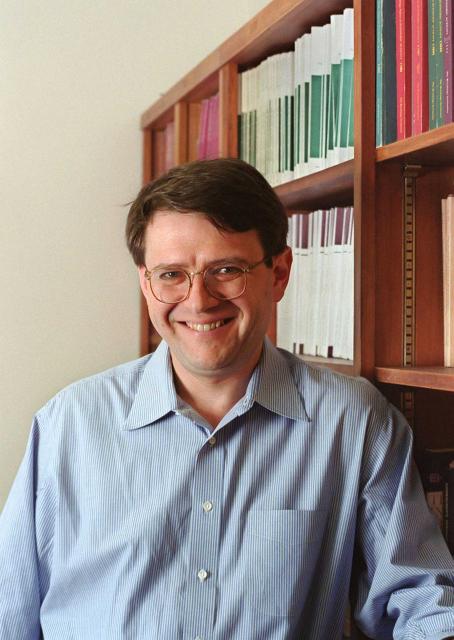
Andrei Shleifer
 USA
USABiography of Andrei Shleifer
Andrei Shleifer, an American economist of Russian origin, was awarded the John Bates Clark Medal in 1999. This prestigious award is given every two years to the most promising American economists under the age of 40. Shleifer received this recognition for his groundbreaking work in the field of corporate finance, financial market economics, and transitional economics.

Born on February 20, 1961, in the USSR, Shleifer emigrated to Rochester, New York, in 1976. He attended a local school and learned English by watching episodes of the television series 'Charlie's Angels.' Shleifer studied economics and obtained a bachelor's degree from Harvard University in 1982 and a Ph.D. from the Massachusetts Institute of Technology (MIT) in 1986.
During his first year at Harvard, Shleifer took a course in applied mathematics with Brad DeLong, which confirmed that his true calling was not mathematics. However, this experience led him to find his future co-author. Shleifer joined the Harvard University Economics Department in 1991 and later became a professor of economics from 2001 to 2006.
His research primarily focuses on financial economics, particularly in the field of behavioral finance. In subsequent years, Shleifer's studies delved into the theory of legal origins, which asserts that a country's legal traditions are a major factor in its development, particularly in financial matters. Shleifer, along with his co-authors Rafael La Porta, Robert W. Vishny, Simeon Djankov, and Florencio Lopez de Silanes, has written extensively on corporate governance.
In the early 1990s, Shleifer served as an advisor to Anatoly Chubais, the then-Deputy Prime Minister of Russia, and was involved in designing the Russian privatization program. He was tasked with creating a stock market in Russia that would be on par with global standards for long-term loan capital. However, his efforts in this area became entangled in corruption allegations and accusations of prioritizing self-interests.
The U.S. government filed a lawsuit against Harvard, Shleifer, his wife Nancy Zimmerman, his associate Jonathan Hay, and Hay's girlfriend (now wife), Elizabeth Hebert. They were all accused of violating anti-corruption laws by engaging in investment activities in Russia instead of limiting themselves to advisory roles. In 2001, the charges against Zimmerman and Hebert were dismissed. In June 2005, Harvard University and Shleifer announced a preliminary agreement with the U.S. government. On August 3 of the same year, Harvard, Shleifer, and the Department of Justice reached a settlement. Under the terms of the agreement, the university had to pay a fine of $26.5 million to resolve the five-year-long legal proceedings, while Shleifer had to pay $2 million.
Shleifer's conduct was examined by Harvard's internal ethics committee. In October 2006, the economist made a statement indicating that he would remain on the faculty of Harvard University. However, according to the 'Boston Globe' newspaper, Shleifer was stripped of his honorary title as the Whipple V. N. Jones Professor of Economics.
Currently, Shleifer is one of the most influential economists in the world according to IDEAS/RePEc and is one of the most cited scholars in the fields of economics and business.


