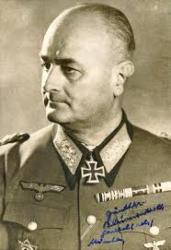
Andrey Vlasov
 Russia
Soviet military leader, participant in the Battle of Moscow
Soviet military leader, participant in the Battle of Moscow. In the yellowed photograph, wise, slightly ironic eyes look at me. And old-fashioned spectacles, affectionately fastened with tape, give them an academic expression. If it weren't for the uniform and the general's stars on the collar, one could assume that the person in the photo is a schoolteacher. The lies of totalitarian ideology gave birth to myths. Myths that became truth for several generations of Soviet people. Some were scared by the actors of these myths, while others were elevated to the rank of heroes. And some particularly resourceful mythmakers managed to earn titles, ranks, and very good social benefits. But history is a terrible thing, and sooner or later, the truth, no matter how unpleasant it may be, becomes known. People, however, usually don't rush to part with myths. It's more convenient that way... In the yellowed photograph, wise, slightly ironic eyes look at me. And old-fashioned spectacles, affectionately fastened with tape, give them an academic expression. If it weren't for the uniform and the general's stars on the collar, one could assume that the person in the photo is a schoolteacher. This photo is over fifty years old. It was taken in the summer of 1941 in besieged Kiev and was only recently declassified from archival storage. Personally, I will never forget when I held it in my hands and read the bold ink stamp on the back that said "DECLASSIFIED". And all these years, the man depicted in the photo had only one title in the Soviet Union - "traitor general".... It reached the point of tragicomedy, some well-known Soviet journalists - namesakes of the general - hurried to prove their non-relationship by signing, "... not a relative of the traitor general." Everything in this world is changeable - in the morning you are a national hero, a favorite of the authorities, and by evening, you may become a traitor. That's the story of Battle General Lieutenant Andrey Vlasov. A story that has been going on for more than half a century. Perhaps it's time, finally, to tell the truth. The truth that not everyone will accept... So - autumn 1941. The Germans attack Kiev. However, they cannot capture the city. The defenses are too strong. And leading the Kiev Special Fortified Region is forty-year-old Major General of the Red Army, Commander of the 37th Army, Andrey Vlasov. He is a legendary figure in the army. He has come a long way - from a private to a general. Having survived the civil war, he completed two courses at the Nizhny Novgorod Theological Seminary, studied at the Academy of the General Staff of the Red Army. A personal friend of Vasily Blucher, Konstantin Rokossovsky, and... Chiang Kai-shek... Before the war, Andrey Vlasov, then a colonel, was sent to China as a military advisor to Chiang Kai-shek. In return, he received the Order of the Golden Dragon (according to other sources, the Order of the White Moon) and golden watches, which caused envy among the entire Red Army generalship. However, Vlasov did not enjoy it for long. Upon returning home, at the Alma-Ata customs, the order, along with other generous gifts from Marshal Chiang Kai-shek, was confiscated by the NKVD... Upon returning home, Vlasov quickly received the rank of general and was appointed to the 99th Rifle Division, known for its backwardness. Within a year, in 1940, the division was recognized as the best in the Red Army and was the first among units to be awarded the Order of the Red Banner of Battle. Immediately after that, Vlasov, by order of the People's Commissar of Defense, took command of one of the four newly created mechanized corps. Led by the general, it was stationed in Lvov and was one of the first units to enter into battle among the Red Army. Even Soviet historians were forced to admit that the Germans "received a punch in the face" for the first time from General Vlasov's mechanized corps. However, the forces were unequal, and the corps was practically destroyed, and the Red Army retreated to Kiev. It was here that Joseph Stalin, impressed by Vlasov's courage and military skills (and based on personal recommendation from Nikita Khrushchev), ordered the general to gather the retreating units in Kiev, form the 37th Army, and defend the city. So, Kiev, August-September 1941. Fierce battles are taking place near Kiev. German troops suffer enormous losses. In Kiev itself... trams are running. People who remember those days claim that only a few shells exploded on the streets during the defense. Nevertheless, the well-known Georgy Zhukov insisted on the surrender of Kiev to the attacking Germans. After a small internal "argument," Joseph Stalin gave the order - "Leave Kiev." It is unknown why Vlasov's headquarters received this order last. History is silent about it. However, according to some unconfirmed information, it was a revenge against the stubborn general. Revenge not by anyone else but General Georgy Zhukov. Just a few weeks ago, Zhukov, inspecting the positions of the 37th Army, came to Vlasov and wanted to stay overnight. Knowing Zhukov's character, Vlasov decided to joke and offered him the best bunker, warning about the night shelling. According to eyewitnesses, after hearing these words, the army general hurriedly retreated from the positions. And in the evening, over dinner, the officers discussed the "departure" of Zhukov in great detail. Of course, the officers present at the dinner were discussing who would risk their lives... And knowing the "informant system of those years," one can only speculate on how quickly Zhukov learned about the conversation of the officers... On the night of September 19, almost undamaged Kiev was left by Soviet troops. Later, we all learned that 600,000 servicemen fell into the "Kiev cauldron" thanks to the efforts of Zhukov. The only one who managed to withdraw his army from the encirclement with minimal losses was "Andrey Vlasov, who did not receive an order to retreat." Vlasov, who had been breaking out of the Kiev encirclement for almost a month, caught a cold and ended up in a hospital with a diagnosis of "middle ear inflammation." However, after a phone call with Stalin, the general immediately went to Moscow. The role of General Vlasov in the defense of the capital is mentioned in the article "Failure of the German plan to surround and capture Moscow" in the newspapers "Komsomolskaya Pravda," "Izvestia," and "Pravda" dated December 13, 1941. Furthermore, in the army, the general was called nothing less than the "savior of Moscow." And in the "Memo on the Commander of the Army Comrade Vlasov A.A.," dated February 24, 1942, signed by Deputy Head of the Personnel Department of the People's Commissariat of Defense of the USSR CC Zhukov and Head of the Sector of the Personnel Department of the Central Committee of the CPSU (b) Frolov, we read: "For work in the position of regiment commander from 1937 to 1938 and work in the position of division commander from 1939 to 1941, Vlasov is characterized as a well-rounded, well-prepared commander in terms of operational and tactical aspects." (Military-Historical Journal, 1993, No. 3, pp. 9-10). Such a thing had never happened in the history of the Red Army. With only 15 tanks, General Vlasov's units stopped Walter Model's tank army in the suburbs of Moscow, in Solnechnogorsk, and pushed back the Germans, who were already preparing for a parade on Red Square, 100 kilometers away, while liberating three cities... He had quite a reputation as the "savior of Moscow." After the Battle of Moscow, the general was appointed Deputy Commander of the Volkhov Front. And everything would have been just great if, after the completely inept operational policy of the Stavka and the General Staff, Leningrad had not been surrounded similar to Stalingrad. And the Second Shock Army, sent to assist Leningrad, was hopelessly blocked in Myasnoy Bor. That's when the most interesting part began. Stalin demanded punishment for those responsible for the situation with the Second Shock Army. But the top military ranks sitting in the General Staff were not eager to "give away" their friends and accomplices who commanded the Second Shock Army. One of them wanted to unilaterally command the front, despite having no organizational skills. The other, no less "skilled," wanted to take away his power. The third of these "friends," who forced Red Army soldiers to march at a parade pace under German shelling, later became a Marshal of the Soviet Union and Minister of Defense of the USSR. The fourth, who gave no clear orders to the troops, pretended to have a nervous breakdown and went... to serve in the General Staff. Stalin, on the other hand, was told that "the command of the group needs strengthening." That's when Stalin was reminded of General Vlasov, who was then appointed commander of the Second Shock Army. Andrey Vlasov understood that he was flying to his own death. As a person who went through the ordeal of the war in Kiev and Moscow, he knew that the army was doomed, and no miracle would save it. Even if the miracle was himself - General Andrey Vlasov, the savior of Moscow. One can only imagine what thoughts were going through the mind of the battle-hardened general in the "Douglas" aircraft trembling from German anti-aircraft fire, and who knows, if the German gunners had been luckier and shot down that "Douglas." What a grimace history would make then. And we would not have the heroic memory of General-Lieutenant Andrey Andreyevich Vlasov, who perished. According to the existing, I emphasize, not yet confirmed information, there was a memorandum on Vlasov's desk. And the Supreme Commander signed it... The further events, according to official propaganda, are as follows - General-traitor A. Vlasov voluntarily surrendered. With all the ensuing consequences... But few people still know that when the fate of the Second Shock Army became obvious, Stalin sent a plane for Vlasov. After all, the general was his favorite. But Andrey Andreyevich had already made his choice. And he refused to be evacuated, sending a wounded military doctor in the plane instead. It is said that this woman is alive to this day. Eyewitnesses of this incident say that the general muttered through his teeth, "What kind of commander abandons his army to perish." As for the claim that Vlasov refused to abandon the soldiers of the Second Shock Army, who were practically dying of hunger due to the criminal mistakes of the Supreme Command, and fly away to save his own life, there is evidence from eyewitnesses. And these witnesses are not Germans, but Russians who experienced the horrors of German and then Stalinist camps and, despite this, did not accuse Vlasov of betrayal. General Vlasov, with a handful of soldiers, decided to break through to his own troops... Soviet propaganda knew its business very well. When the "scandal" surrounding Vlasov began, what was most important? It was far from the fact that he "betrayed." The focus was on the fact that he had "women." Many women... Interestingly, at the same time, and in the same years, Georgy Zhukov and Konstantin Rokossovsky, the national heroes, had just as many women. Moreover, the personal lives of these "non-traitors" were supervised personally by Joseph Stalin... But the press and propaganda preferred to remain silent about that. They chose to make General Vlasov, with his two OFFICIAL and LEGAL wives, the main debaucher of the Red Army. On the night of July 12, 1942, Vlasov and a handful of his soldiers reached the Old Believer village of Tukhovezhi and took shelter in a barn. And that night, it was not the Germans who burst into the barn where the surrounded soldiers found refuge. To this day, it is unknown who these people truly were. According to one version, they were self-proclaimed partisans. According to another, armed local residents, led by the church elder, decided to buy the favor of the Germans at the cost of general's stars. That same night, General Andrey Vlasov and the soldiers accompanying him were handed over to regular German troops. It is said that the general was severely beaten before that. Noticeably, by his own people... One of the Red Army soldiers accompanying Vlasov testified to the SMERSH investigators, "When they handed us over to the Germans, they wanted to shoot everyone without a word. The general stepped forward and said, 'Don't shoot! I am General Vlasov. My men are unarmed!' That's the whole story of the 'voluntary surrender.' By the way, from June to December 1941, 3.8 million Soviet servicemen ended up in German captivity. In 1942, over a million more, totaling about 5.2 million people during the war. And then there was a concentration camp near Vinnitsa, where senior officers representing the interest of the Germans were held - prominent commissars and generals. Much was written in the Soviet press about how Vlasov, supposedly, lost control of himself, and tried to save his life. However, documents suggest otherwise. Here are excerpts from official German and personal documents that fell into SMERSH's possession after the war. They characterize Vlasov from a different perspective. These are documentary testimonies of Nazi leaders, who cannot be suspected of sympathizing with the Soviet general, whose efforts led to the destruction of thousands of German soldiers near Kiev and Moscow. For example, Hilger, an advisor at the German embassy in Moscow, briefly described his interrogation of the captive General Vlasov on August 8, 1942: "He creates the impression of a strong and direct personality. His judgments are calm and balanced" (Archive of the Institute of Military History of the Ministry of Defense, d. 43, l. 57). And here is what Goebbels thought of the general. After meeting with Vlasov on March 1, 1945, he wrote in his diary, "General Vlasov is an extremely intelligent and energetic Russian military leader; he made a very deep impression on me" (Goebbels, J. The Last Entries. Smolensk, 1993, p. 57). When it comes to Vlasov, it seems clear. Perhaps the people who surrounded him in the ROA were the scoundrels and idlers who were just waiting for the war to start so they could switch sides to the Germans. But no, even here the documents give no reason to doubt. Vlasov's closest associates were highly professional military leaders who had been awarded high honors by the Soviet government for their professional activities at different times. For example, Major General V.F. Malyshkin was awarded the Order of the Red Banner and the Medal "XX Years of the Red Army"; Major General F.I. Trukhin - the Order of the Red Banner and the Medal "XX Years of the Red Army"; G.N. Zhilenkov, Secretary of the Rostokino District Committee of the All-Union Communist Party (Bolsheviks) in Moscow - the Order of the Red Banner of Labor (Military-Historical Journal, 1993, No. 2, pp. 9, 12). Colonel M.A. Maltsev (Major General of the ROA), commander of the Air Force of the KONR, was once a flight instructor of the legendary Valery Chkalov ("Voice of Crimea," 1944, No. 27, Editor's Afterword). And Colonel Aldan A. G. (Neryanin), Chief of Staff of the Armed Forces of the KONR, was highly praised upon graduation from the Academy of the General Staff in 1939. The then Chief of the General Staff, Army General Shaposhnikov, called him one of the brilliant officers of the course, the only one who graduated from the Academy with "excellent." It is hard to imagine that all of them were cowards who joined the Germans to save their own lives. By the way, if we are talking about documents, let's remember another one. When General Vlasov ended up with the Germans, the NKVD and SMERSH, on Stalin's orders, conducted a thorough investigation into the situation with the Second Shock Army. The results were put on Stalin's desk, and he came to the conclusion that the accusations against General Vlasov in the death of the Second Shock Army and his military unpreparedness were groundless. And what kind of unpreparedness can there be when the artillery did not even have ammunition for a single salvo... Victor Abakumov (remember this name) conducted the investigation on behalf of SMERSH. Only in 1993, after the collapse of the Soviet Union, did the truth about General Vlasov begin to emerge. It was then that the archives were opened, and the documents that had been hidden from the public for decades came to light. The true story of Andrey Vlasov, the battle general who was branded a traitor, is far more complex and tragic than the mythical image created by Soviet propaganda.