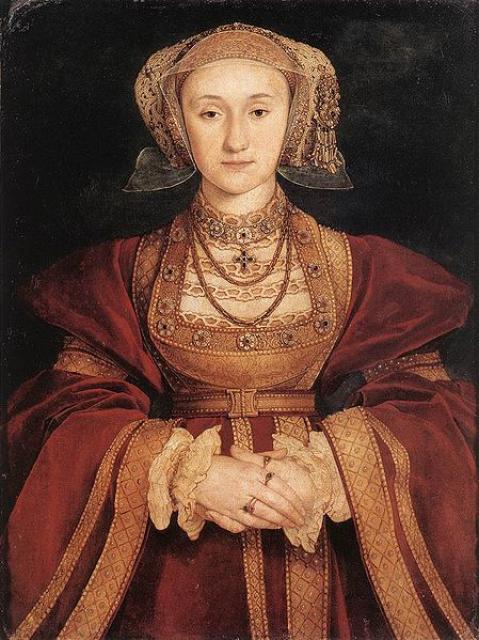
Anna Kleve
 Great Britain
Biography of Anna of Cleves
Early LifeAnna of Cleves, the fourth wife of King Henry VIII of England, was born on September 22, 1515, in Düsseldorf, in the family of Duke Johann III of Cleves and Maria of Jülich-Berg. She belonged to the ancient Lamarck family through her father. Not much is known about her childhood and youth, but it is known that she was close with her older sister Sibylla, who would later become the wife of the Elector of Saxony, and often visited her aunt, Maria of Habsburg, in Brussels.
Marriage to Henry VIII
After the death of Jane Seymour, King Henry VIII resumed his search for a suitable wife. Among the candidates were Maria de Guise, Christina of Milan, and Maria of Habsburg (sister of Charles V). However, all of them politely declined the offer from the English king due to his notorious reputation in Europe. Thomas Cromwell, a supporter of the Reformation, convinced the king that marrying a Catholic would lead to the emergence of a strong "Papist party" at court. As a result, the choice fell on the sisters of Duke Wilhelm of Cleves, who sympathized with the Protestants - Anna and Amalia. In August 1539, the court painter Hans Holbein went to paint portraits of the sisters "on the continent." However, Holbein painted Anna's portrait not from life, but from the work of another, less skilled artist. The portrait of Anna made an excellent impression on Henry. He was not bothered by the fact that his chosen one had been briefly engaged to the Duke of Lorraine - according to English law, the new marriage could not be considered legitimate. On September 4, 1539, the marriage contract was signed. In early 1540, Anna arrived in England, and the first meeting of the bride and groom took place in Rochester, where Henry arrived incognito. One look at Anna was enough - the king was disappointed. Instead of the pale and delicate beauty depicted by Holbein, he saw a large, robust woman with rather coarse facial features. Henry vented his anger on Cromwell, who allegedly "presented him with a huge Flemish mare." However, some researchers of Henry VIII's life believe that Anna's appearance was not the reason for his repulsion, but rather her inability to socialize, her terrible German style of dress, and complete lack of grace. Anna also did not like Henry, especially since she had heard rumors about Anne Boleyn's downfall while she was in Cleves. Henry's words, "I do not like her," were equivalent to a demand to "Find me another wife!" The Privy Council began to look for ways to annul the engagement. However, the wedding took place - Henry did not want to enter into a conflict with Anna's brother. Anna of Cleves lived in England for six months, but her husband did not pay her much attention. She became a kind stepmother to Prince Edward and the Princesses Bessie and Mary.
Life as "Sister"
Anna quickly adapted to life at the English court - she loved music and dancing, and she also had dogs and parrots, which were very popular in England. In 1540, a young girl from the Howard family, named Catherine Howard, was appointed to serve in Anna's household. Catherine had been at court since 1539, thanks to the patronage of her influential uncle, Sir Thomas Howard, Duke of Norfolk. Henry became more and more disappointed in Anna of Cleves. The instigator of this marriage, Thomas Cromwell, was arrested and imprisoned in the Tower, while Anna was sent to Richmond Castle. Anna liked the castle very much and would have been happy to stay there, as she was afraid of being executed due to the king's whims. Henry had no complaints against Anna and had no intention of executing her. He only needed a divorce in order to marry the young Catherine Howard. The formal reason for the divorce was the documents related to Anna's first engagement with the Duke of Lorraine. According to English law, Anna could no longer remain Henry's wife, and their marriage was declared invalid. On July 9, 1540, based on this fact, a divorce petition was filed, and Henry Tudor and Anna von Cleves became free.
Later Life and Death
Thomas Cromwell only lived long enough to give evidence in the divorce case - on June 28, 1540, he was executed on charges of treason and heresy. Henry left Anna in his family - as a "sister." This was dictated by a number of circumstances: Anna of Cleves had become beloved by the king's children, and several courtiers found her extremely kind and pleasant. Henry did not want to enter into a conflict with Anna's brother, the Duke of Berg-Jülich-Cleves, who was one of the most influential rulers in Germany. Anna also genuinely loved her new homeland. Henry proclaimed Anna his "sister," and she remained the highest-ranking lady after the new queen and the princesses Mary and Bessie. Anna received generous gifts from the king, including Richmond and Hever castles, as well as a substantial annual income. Correspondence between Henry and Anna indicates that the former spouses lived very amicably. The king always signed his letters "Loving Brother Henry." Anna never remarried. She outlived both Henry VIII and his son Edward VI. Anna of Cleves died on July 16, 1557, in London, during the penultimate year of Mary I's reign. She was buried in Westminster Abbey.


