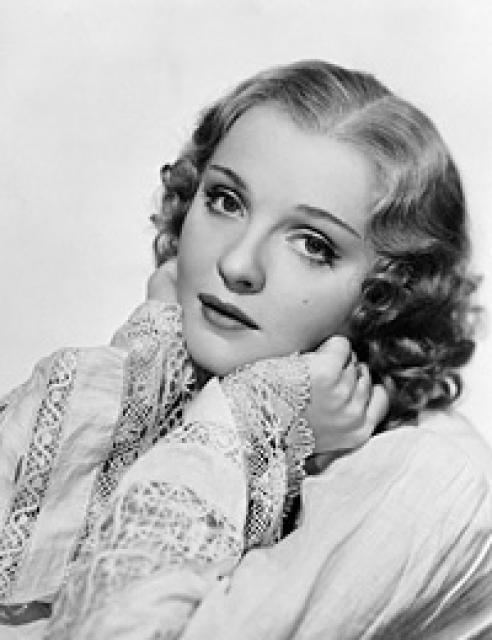
Anna Sten
 Ukraine
Biography of Anna Stan
Anna Stan, a Ukrainian-born film and theater actress, was born on December 3, 1908, in Kiev. Her father, a dancer and theater artist, passed away in 1917, while her mother, of Swedish origin, was a ballerina. During her childhood, Anna practiced dancing and took piano lessons. There is limited information available about her early career, with most of it being semi-legendary and difficult to verify. It is believed that after her father's death, Anna worked as a waitress before getting involved in amateur theater. At the age of fifteen, she caught the attention of Konstantin Stanislavski, who provided her with patronage and secured her admission to the Moscow Film Academy.
There is some confusion regarding Anna's stage name. While she was born Anel Sudakevich, it is believed that she adopted the pseudonym Anna Stan. However, film credits for the movie "Zemlya v plenu" include both names, suggesting the possibility of two different actresses or an error. Some sources also mention Anel Sudakevich under the name Stan or Anna Stenskaya-Sudakevich. This confusion may stem from the coincidence of names between two actresses who worked in Soviet cinema during the same period.
Anna made her debut in silent film in 1926, playing a small role as a stenographer in the comedy "Miss Mend." The film was written by Boris Barnet, who later became a renowned Soviet film director and directed the anti-war film "Outskirts," which won the Venice Film Festival award in 1933. Anna married Fyodor Otsep, who played the lead role in "Miss Mend" and served as assistant director to Fyodor Ocep. In the following years, Otsep directed Anna in four more films.
Her career in the Soviet Union progressed rapidly, and she landed leading roles as early as 1927. She worked with Barnet again in the comedy "The Girl with the Hatbox," followed by prominent roles in films such as "Earth in Chains," "My Son," and "White Eagle," directed by Yakov Protazanov, Vasily Kachalov, and Vsevolod Meyerhold, respectively. Some of her early films were shown internationally and received acclaim. In 1930, Anna traveled to Germany under the auspices of Mezhrabpomfilm, where she appeared in the sound film "Der Buchhalter Kremke." She decided not to return to her homeland and continued her career in Europe, following her husband's emigration.
In 1931, Otsep directed Anna in two films, both successful adaptations of Fyodor Dostoevsky's novel "The Brothers Karamazov." One version was made in France, titled "Les Frères Karamazov," and the other was a German production called "Der Mörder Dimitri Karamasoff," where Anna played the role of Grushenka. During the filming, she developed a romance with the producer, Yevgeny Frenkel, leading her to leave Otsep and eventually marry Frenkel. In the same year, Anna appeared in two more films, "Salto Mortale" and "Bombs Over Monte Carlo," as well as a drama called "Storms of Passion" alongside the renowned Emil Jannings.
In 1932, Anna gained the attention of producer Samuel Goldwyn, who invited her to Hollywood. Despite not knowing the language, she dedicated herself to learning English and reducing her accent for about a year before arriving in America. Her first American film, "Nana," based on Émile Zola's novel, was released in 1934 but did not achieve commercial success. Over the next two years, Anna appeared in films directed by prominent filmmakers and alongside Hollywood stars, albeit infrequently. In 1934, she played Katusha Maslova in Ruben Mamoulian's drama "We Live Again," an adaptation of Leo Tolstoy's "Resurrection," co-starring Fredric March. In 1935, she starred opposite Gary Cooper in King Vidor's melodrama "The Wedding Night," which won the Venice Film Festival award for Best Director. This film became the peak of her career.
Unfortunately, Anna was unable to break through as a major star. In 1936, she appeared in her husband Frenkel's melodrama "A Lonely Woman," with a screenplay written by Otsep. Afterward, she disappeared from the screen for three years and, except for the war drama "Exile Express" in 1939, she appeared sporadically and mostly in supporting roles. The year 1943 marked her last productive period, with three war-themed films: "The Chetniks," "They Came to Blow Up America," and "Three Russian Girls," in which she played leading roles. Her final works were the war drama "The Nun and the Sergeant" in 1962 and the 1964 TV series "Arrest and Trial." Anna Stan passed away on November 12, 1993, at the age of eighty-five, due to a heart attack.
In mid-1930s Hollywood, Anna became known for her sense of style and wardrobe selection. Film producer Darryl Zanuck claimed she dressed better than anyone he had ever seen. Woman director Dorothy Arzner, who directed Stan in "Nana," included her in a list of the most stylish actresses alongside Greta Garbo, Miriam Hopkins, Katharine Hepburn, and Ruth Chatterton.