Anton Fernkorn
 Austria
- Franz Xaver Fernkorn
- Vienna and Baroque Revival
- Prince Eugene Equestrian Statue and Illness
- Portraiture and Animal Sculptures
- Legacy and Memorial
Franz Xaver Fernkorn
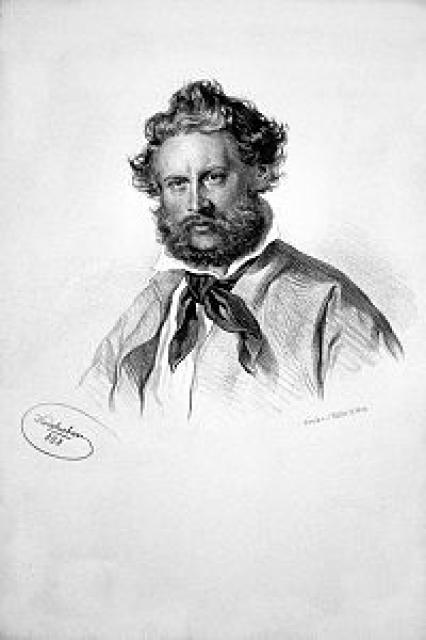
Franz Xaver Fernkorn was an Austrian sculptor born in Erfurt, Thuringia, and passed away in Vienna, Austria. He pursued his artistic training under the guidance of Ludwig Michael Schwanthaler in Munich.
Vienna and Baroque Revival
In 1840, Fernkorn relocated to Vienna and became a vocal proponent against the prevailing neoclassical style. His passion for Baroque sculpture found expression in his equestrian statue of Archduke Karl (1859), commemorating the victory over Napoleon in the Battle of Aspern-Essling. This masterpiece showcased his exceptional ability to depict a monumental horseman and his steed poised on its hind legs.
Prince Eugene Equestrian Statue and Illness
Fernkorn's subsequent equestrian statue of Prince Eugene of Savoy proved less successful. By the time of its unveiling in 1865, Fernkorn's mental illness had rendered him unable to continue his artistic endeavors.
Portraiture and Animal Sculptures
Beyond his monumental works, Fernkorn was also renowned for his sculptures of notable figures, including a bust of Emperor Franz Josef I. His skill as an animal sculptor manifested in works such as the Aspern Lion in Vienna. Furthermore, Fernkorn served as the director of the Imperial Foundry in Vienna.
Legacy and Memorial
Franz Xaver Fernkorn's resting place can be found in Vienna's magnificent Zentralfriedhof. His tomb, designed by fellow sculptor Joseph Bayer, features a relief of the artist in his working attire, surrounded by images of his most celebrated creations.