Antoni Kamienski
 Poland
- Early Life and Education
- Artistic Career in Poland and Paris
- Return to Warsaw and World War I
- Military Service and National Identity
- Artistic Legacy
- Literary Pursuits and Political Engagements
- Death and Legacy
Early Life and Education
Aleksander Kamieński was born in Poland in 1863. He studied at the St. Petersburg Academy of Arts from 1882 to 1885, where he developed his skills in painting and graphic arts.
Artistic Career in Poland and Paris
In 1886, Kamieński interrupted his studies to return home due to financial difficulties. He later moved to Warsaw in 1890 to pursue his passion for art. He became a collaborating artist for the popular magazine "Tygodnik Ilustrowany," which published numerous of his illustrations.
In 1891, Kamieński relocated to Paris and enrolled in the Académie Julian. He studied painting and sculpture under renowned artists such as William-Adolphe Bouguereau, Benjamin Constant, and Jean-Paul Laurens. His illustrations were published in French and British magazines, including "Le Monde Illustré" and "The Graphic."
Return to Warsaw and World War I
Kamieński returned to Warsaw in 1894, where he worked for local magazines. He visited Paris several times between 1898 and 1914. During World War I, he resided in Paris. As a Russian citizen, he was detained at the border with Austria while attempting to return to Poland.
Military Service and National Identity
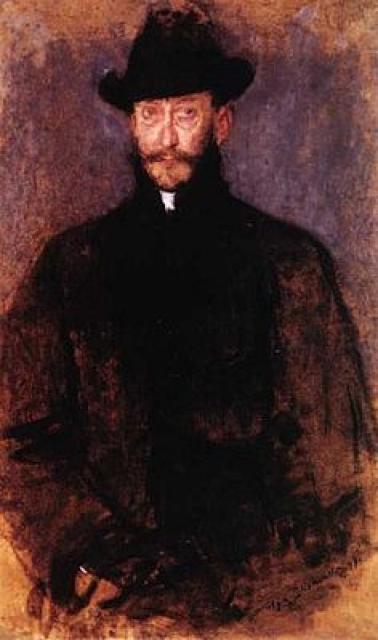
In 1919, Kamieński enlisted in the Polish army of Józef Haller. He was inspired by the national revival of Poland and painted a portrait of Józef Piłsudski.
Artistic Legacy
Kamieński's body of work includes numerous graphic drawings, watercolors, and caricatures published in local and international magazines. He also created a series of sketches and essays on the Białowieża Forest, published in the album "Ocherki Belovezhskoy Pushchi" (1912).
He illustrated works by renowned authors such as Hans Christian Andersen, Eliza Orzeszkowa, and Maria Konopnicka. In addition to oil painting, Kamieński explored techniques like etching, lithography, and drypoint.
Literary Pursuits and Political Engagements
Kamieński expressed liberal ideas in his art, such as the drawing "Gathering of Russian Socialist Youth" (1891). He created a series of lithographs entitled "Spirit of Revolution" (1905) in response to the revolutionary events of that year.
In 1907, Kamieński published a novel entitled "Spring Morning." He also shared his memoirs of his time in Paris in "Tygodnik Ilustrowany."
Death and Legacy
Kamieński died in Warsaw in 1933, largely forgotten. He was buried in the Stare Powązki cemetery in Warsaw.