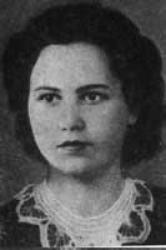
Antonina Diachenko
 Ukraine
Biography of Antonina D'yachenko
Antonina Nikolaevna D'yachenko was born on November 2, 1925, in the village of Krasnodon, in a working-class family. Her father, Nikolai Ivanovich, was a recipient of the Order of Lenin and had participated in the elimination of White Guard gangs in the 1920s. Antonina excelled in her studies and had a great love for reading books about sea voyages. She also played the guitar and had a beautiful singing voice. Her classmates admired her performances in school concerts.
In 1940, Antonina became a member of the Komsomol, the youth wing of the Communist Party. She had plans to attend a textile technical school with her friend Zhenya Kiikova after completing her eighth grade in the spring of 1941. However, their plans were disrupted by the outbreak of war. During the summer, Antonina worked with her classmates in a collective farm, harvesting crops. In the fall, she was appointed as the pioneer leader for the sixth grade.
Under Antonina's guidance, the sixth-grade students prepared gifts for the front and wounded soldiers in hospitals. She taught the girls how to sew bags, embroider handkerchiefs, knit socks, and mittens. They also cleared the railway tracks of snow together.
In February 1942, Antonina brought a newspaper called "Komsomolskaya Pravda" to her class. Everyone saw a portrait of a girl with a loop around her neck. Under the photo, there was a large article titled "Tanya." Antonina read the article by correspondent Lidov, and it brought tears to their eyes. She expressed her admiration for Tanya's heroism and loyalty to the Motherland. Antonina's emotional words made her classmates believe that she would act similarly if faced with similar circumstances. Little did they know that their intelligent and patriotic friend would soon follow in the footsteps of the famous partisan, Zoya Kosmodemyanskaya.
In October 1942, Antonina D'yachenko joined the underground Komsomol organization called "Molodaya Gvardiya" (Young Guard). She carried out various assignments given by the headquarters. Alongside her fellow fighters, she cut telephone and telegraph wires on the steppes, burned bread supplies intended for Germany that the fascists had collected. Her friends, including Zhenya Kiikova, Yuri Polyansky, Volodya Zhdanov, and Nikolai Sumsky, frequently visited Antonina. Volodya Zhdanov brought leaflets with summaries from Sovinformburo, which the young guards used to write texts for leaflets.
On the night of January 12, 1943, Antonina D'yachenko was arrested, and on January 14, the arrested young guards were transferred from the village to the city of Krasnodon. On January 16, after enduring cruel tortures, Antonina and a group of underground Komsomol members were executed and thrown into the shaft of Mine No. 5. She was buried in a mass grave for the young guards on the central square of Krasnodon. Antonina Nikolaevna D'yachenko was posthumously awarded the Medal of "Partisan of the Patriotic War" of the 1st degree.