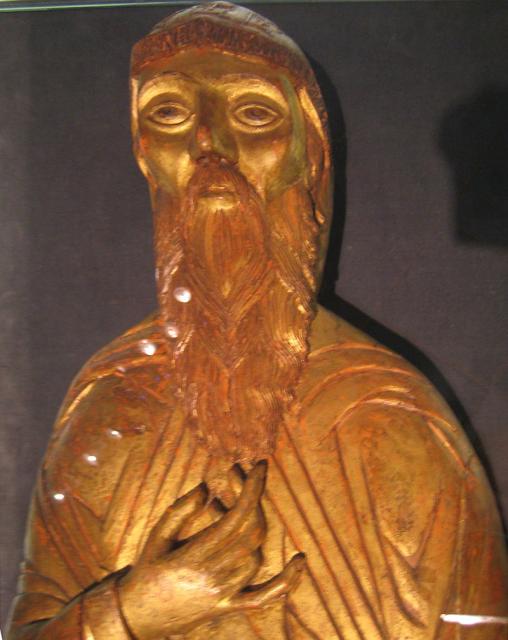
Antoniy Rimlyanin
 Italy
Italy- Saint Anthony of Rome, Founder of the Antoniev Monastery in Novgorod
- Flight from Persecution and Miraculous Journey
- Establishment of the Antoniev Monastery
- Abbotship and Discipleship
- Canonization and Legacy
- Roman Origins and Folklore
- Influence on Russian Folklore
Saint Anthony of Rome, Founder of the Antoniev Monastery in Novgorod
Early Life and Monastic CallingBorn in Rome to devout parents, young Anthony devoted himself to God at the age of 18 after losing his family. He distributed his wealth to the poor and took monastic vows, diligently studying Greek and immersing himself in sacred texts.
Flight from Persecution and Miraculous Journey
When persecution against Orthodoxy intensified in his region, Anthony fled his monastery and spent a year in prayer on a seaside cliff. Miraculously, the rock he stood on detached and carried him across the "warm sea" (possibly the Mediterranean), the Neva River, Lake Ladoga, and the Volkhov River, arriving in Novgorod in just three days.
Establishment of the Antoniev Monastery
With the help of Bishop Nikita of Novgorod, Anthony founded a monastery dedicated to the Nativity of the Blessed Virgin Mary. He purchased land and adorned the monastery with his remaining possessions, which had been found in a barrel salvaged by fishermen. In 1117, a stone church was built, consecrated in 1119.
Abbotship and Discipleship
In 1131, Anthony was appointed abbot of the monastery he had founded. He led the community for 16 years, designating the monk Andrew as his successor upon his passing. Andrew is credited with writing Anthony's hagiography.
Canonization and Legacy
Anthony of Rome was officially canonized in 1597, and his relics were transferred to the monastery's Nativity Cathedral. His life story is largely legendary, but historical evidence supports his existence, including his monastery's construction and his death recorded in Novgorod chronicles.
Roman Origins and Folklore
While Anthony was venerated locally before his canonization, his Roman origins were not emphasized until the mid-16th century. The legend of his journey from Rome to Novgorod may have emerged during a period of cultural exchange (late 16th - early 17th century). The term "Romanian" could also refer to individuals from the Holy Roman Empire or those involved in trade with these regions.
Influence on Russian Folklore
Anthony's miraculous voyage on the rock became a popular tale in Russian folklore, inspiring subsequent stories and beliefs.




