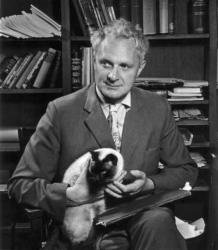
Antoniy Slonimski
 Poland
- Antoni Słonimski: A Literary Force
- Early Life and Influences
- Education and Literary Beginnings
- Literary Career
- World War II and Emigration
- Literary Controversies and Opposition
- Legacy
Antoni Słonimski: A Literary Force
Antoni Słonimski, a renowned Polish poet, playwright, and literary critic, made significant contributions to 20th-century Polish literature.
Early Life and Influences
Born into a distinguished Jewish family, Słonimski was the grandson of the prominent publisher and scientist Chaim-Zelik Słonimski (1810-1904). His extended family included notable figures such as the musician Nicolas Slonimsky, the writers Alexander and Mikhail Slonimsky, and the philologist Yosef Zelikovic Słonimski. Słonimski's father, a physician, became the inspiration for Dr. Szuman in Bolesław Prus's novel "The Doll."
Education and Literary Beginnings
Słonimski completed his studies at the Academy of Fine Arts in Warsaw (1917). He co-founded the literary cabaret "Pikador" (1918) and played a key role in establishing the poetry group "Skamander." His debut collection of poems, "Sonety" (1918), marked the beginning of his literary career.
Literary Career
Słonimski's writings reflected his strong opposition to imperialism and fascism. His anti-war poem "Black Spring" (1919) and collections such as "Parade" (1920) and "Time of Poetry" (1923) denounced the horrors of the First World War. He also authored science fiction novels, political satires, and comedies, including "The Tower of Babel" (1927).
World War II and Emigration
During the Second World War, Słonimski resided in Paris and London. He published patriotic and anti-fascist poetry in collections like "Alarm" (1940) and "Ashes and Wind" (1940-1941). After the war, he remained in exile, serving as head of UNESCO's literature section until 1948 and directing the Polish Institute of Culture. Despite returning to Poland in 1951, he never fully reintegrated into the literary scene.
Literary Controversies and Opposition
Słonimski's outspoken criticism of literary history textbooks in 1954 led to a ban on his works. However, during the "Polish Thaw," he was elected president of the Union of Polish Writers (1956-1959). After his ouster by the party leadership, Słonimski became a prominent opposition figure. He was instrumental in drafting the "Letter of 34" (1964), which protested the cultural policies of the Polish United Workers' Party, and denounced the anti-Semitic campaign of 1968.
Legacy
Antoni Słonimski left an enduring legacy as a prolific writer and an advocate for free expression. His works continue to inspire and challenge readers, cementing his status as a significant figure in Polish literary history.