Arion
Arion was celebrated in ancient Greece as a brilliant singer and player of the cithara, a large lyre used by professional performers. His name is also tied to the origin of the dithyramb, a choral song associated with Dionysus, and to one of antiquity’s most enduring stories: a dolphin carrying a musician safely to shore.
Musician of Lesbos
Arion was said to come from Methymna, a city on the island of Lesbos, and to have lived in the late seventh or early sixth century BCE. The details of his life are difficult to separate from legend, but the fifth-century historian Herodotus described him as the finest cithara player of his time. He was associated with Corinth and its ruler Periander, and was remembered as a performer whose reputation reached far beyond his home island.
Herodotus credited Arion with being the first person known to compose and name the dithyramb and to teach it at Corinth. Later tradition likewise connected him with the development of choral performance. The exact nature of his contribution is uncertain: the form existed in Greek musical culture before the surviving accounts, so he may have organized and shaped an established tradition rather than invented it outright. Even so, ancient writers regarded him as a foundational figure in the history of Greek song and theater.
The dolphin legend
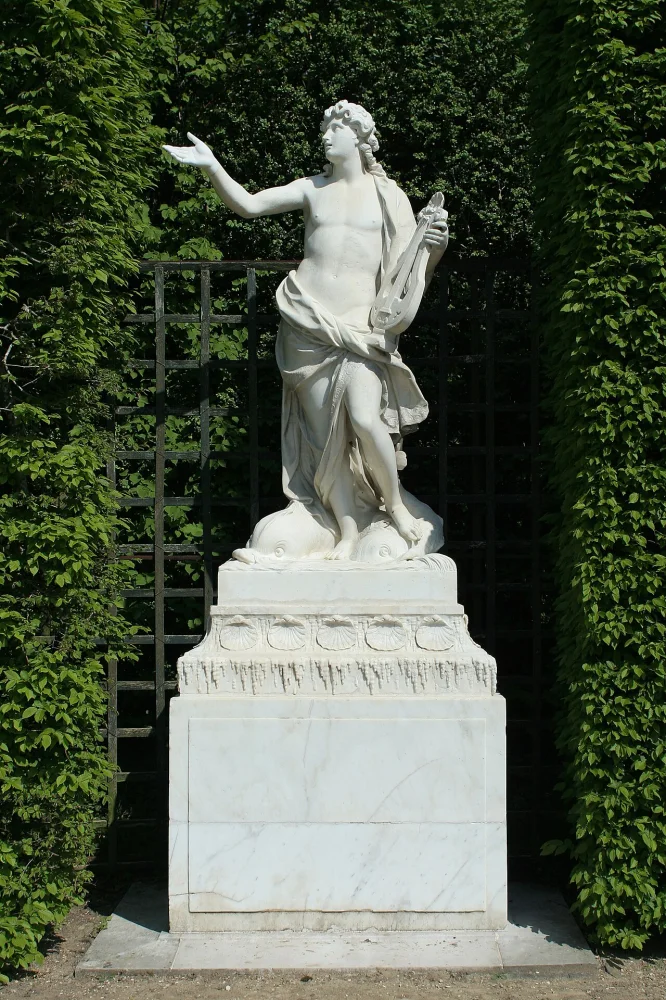
The story that made Arion famous beyond the musical world was recorded by Herodotus. After winning a performance contest in southern Italy, Arion boarded a ship to return to Corinth. The sailors, hoping to take his wealth, plotted to kill him. Herodotus says that Arion asked to sing one final song in his ceremonial costume. He then leapt into the sea, where a dolphin carried him to Taenarum, a headland in southern Greece.
Arion reached Corinth before the ship’s crew and told Periander what had happened. When the sailors arrived, the ruler questioned them; their claim that Arion had been left behind was undermined when the musician appeared. Herodotus notes that a small bronze dedication at Taenarum showed a man riding a dolphin, and that both the people of Corinth and those of Lesbos told the story.
The account is best approached as an ancient legend rather than a verifiable travel narrative. Its themes—divine protection, the power of music, and the exposure of betrayal—help explain why it remained popular in literature and art for centuries.
A lasting cultural image
No complete body of Arion’s poetry survives, and little can be established about his personal life beyond the traditions attached to his name. Yet he occupies a vivid place in Greek cultural memory: a master musician credited with shaping choral poetry and a legendary survivor whose art seems to command even the natural world. His story continued to inspire poets, painters, and composers, turning the dolphin and cithara into enduring symbols of the performer’s power.