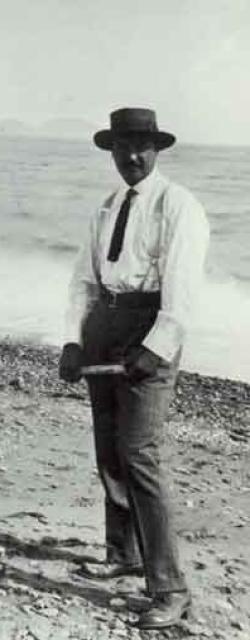
Aristarkh Lentulov
- Aristarkh Lentulov: Soviet Avant-Garde Artist
- Early Life and Education
- Artistic Influences and Style
- "Jack of Diamonds" and Other Affiliations
- Transition to Realistic Painting
- Theatrical Achievements
- Teaching Career
Aristarkh Lentulov: Soviet Avant-Garde Artist
Aristarkh Vasilyevich Lentulov was a prominent Soviet avant-garde artist who achieved fame primarily through his theatrical designs.
Early Life and Education
Born on January 16, 1882, Lentulov began his artistic journey at the Penza and Kiev Art Schools (1897-1907). He later trained under D.N. Kardovsky (1908-10) and at a private studio in Paris (1911).
Artistic Influences and Style
In the 1910s, Lentulov's artwork was heavily influenced by Cubism, Futurism, and Orphism. These modern art movements were combined with his keen interest in ancient Russian architecture, iconography, and folk art (e.g., "The Bell," 1915; "Near the Iverskaya," 1916).
"Jack of Diamonds" and Other Affiliations
Lentulov was a co-founder of the "Jack of Diamonds" association (1910), which played a significant role in promoting avant-garde art. He was also a member of the Association of Artists of Revolutionary Russia (AkhRR) from 1926 and the Society of Moscow Artists (OMKh) from 1928.
Transition to Realistic Painting
In the early 1920s, Lentulov gradually shifted from large-scale murals to smaller and more naturalistic works. As Chairman of the Society of Moscow Artists (1928), he explored tonal painting, maintaining remnants of his former bold colors in landscapes, portraits, and still lifes (e.g., "Sunset on the Volga," 1928; "Vegetables," 1933).
Theatrical Achievements
Lentulov's artistic energy found its fullest expression in theatrical design, which aligned well with his optimistic and exuberant personality. He collaborated extensively with directors A.Y. Tairov, F.F. Komissarzhevsky, and V.I. Nemirovich-Danchenko. Among his most renowned theatrical designs was the staging for "The Spanish Priest" (1934) at the Moscow Art Theatre 2nd.
Teaching Career
Beyond his artistic pursuits, Lentulov played an active role as an educator at Vkhutemas (from 1920) and the Moscow State Art Institute (1937-43).


