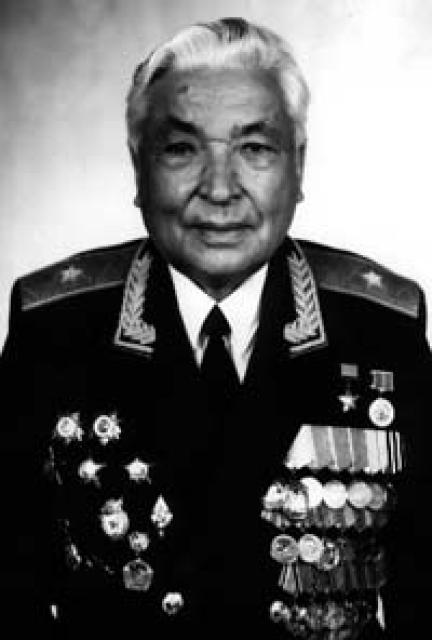
Dayir Asanov
 Kyrgyzstan
Biography of Dair Asanov
Dair Asanov was a Soviet artilleryman, participant of the Great Patriotic War, and a Hero of the Soviet Union (1943). He was born on May 30, 1922, in the village of Bashkaindy, Atbashinsky District, Naryn Oblast, Kyrgyz Republic, in a peasant family. He completed secondary school in 1941 and worked as an accountant and a teacher in a rural seven-year school before being drafted into the army.
During the war, Asanov served as a gunner and commander in the 1208th Fighter Anti-Tank Artillery Regiment of the 31st Anti-Tank Light Artillery Brigade of the 11th Artillery Breakthrough Division. He fought on the Southwest, Don, Stalingrad, Steppe, and 2nd Ukrainian Fronts. In January 1942, he received his baptism of fire. He set a tank on fire, suppressed a machine gun nest, and destroyed an enemy vehicle with ammunition, for which he was awarded the Medal "For Military Merit."
Later, Dair Asanov participated in the battles surrounding the encirclement, defeat, and capture of the elite group of German troops in the Don and Volga interfluve during the defense of Stalingrad. He vividly remembered the powerful artillery preparation of the Soviet troops near Stalingrad at dawn on September 26, 1942, when hundreds of guns and mortars unleashed a hurricane of fire on the heads of the Germans. His regiment, armed with new 76mm guns, had to engage enemy tanks in direct combat. In these battles, Asanov managed to destroy four tanks, six firing points, a convoy of five vehicles with ammunition, and up to 30 German soldiers with his artillery fire. He was wounded twice and concussed but remained in combat. For his courage and bravery in the Battle of Stalingrad, he was awarded the Orders of the Patriotic War 1st Class and the Red Star. But the greatest trials were still ahead.
In the second half of March 1943, fierce defensive battles were fought by Soviet troops east and northeast of Kharkov. The second and sixth batteries of the 1208th Fighter Anti-Tank Artillery Regiment, in which Asanov served, covered the retreat of Soviet troops on the Seversky Donets River. The gun crews took up firing positions on the western outskirts of the village of Pyatnitskoye in the Chuguevsky District. They dug trenches and camouflaged themselves. At 9 o'clock in the morning on March 2, enemy bombers made a raid on their positions. Tanks and infantry followed from the direction of Zarozhnoye and Bolshaya Babka. Allowing the Germans to approach within a distance of 300-500 meters, the artillerymen accurately hit several enemy vehicles. The enemy couldn't withstand the direct fire and retreated. However, the Soviet soldiers suffered heavy losses: the brave commander of the sixth battery, Senior Lieutenant Mikhaylenko, was killed, and many soldiers were wounded, and the guns were destroyed.
Those who survived swore to die rather than let the enemy through. When a new attack began and the main enemy tank was only about 300 meters away, Asanov opened fire. His shell hit the target precisely, causing the enemy tank to first smoke and then catch fire. The artilleryman continued to aim and fire. Soon, after losing three tanks, the Germans hurried to withdraw from the battlefield. However, the respite was short-lived. The enemy launched another attack with the support of 11 tanks and aviation. The battle became fierce, and chaos reigned. The gun crew lost four soldiers, killed in action. Asanov continued to fire, and two more enemy tanks went up in flames. To support the troops facing defeat, the enemy sent six armored vehicles with infantry. But they also fell victim to the accurate fire of the gunner. Dair loaded the shells, aimed, and fired himself, exhibiting incredible effort to maintain a rate of fire of 10-15 shots per minute. The enemy indiscriminately fired at the entire settlement, believing that it was not just one artillery unit defending it but a whole division. The direct hit of an enemy shell destroyed Asanov's gun, and he himself was concussed. When he regained consciousness, he saw German infantry closing in from all sides. Dazed and completely exhausted, Dair gathered all his strength and began to shoot them with his machine gun. Soon, help arrived.
In just one day of unequal combat, Dair Asanov destroyed 8 tanks, 6 armored vehicles, and more than 40 enemy infantrymen. His heroic feat was highly appreciated by his homeland. By the decree of the Presidium of the Supreme Soviet of the USSR on October 26, 1943, he was awarded the title of Hero of the Soviet Union. After the war, D.A. Asanov graduated from the 1st Guards Ulyanovsk Tank School (1946), the Tashkent Higher Tank School (1950), and the Military-Political Academy (1956). He served in the army as a tank platoon and company commander (1946-1951), deputy regimental commander for political affairs (1956-1960). He worked as a propagandist in the Political Department of the Military Commissariat of the Kyrgyz Republic, military commissar of the combined Tokmak Military Commissariat of the city and Chui District, military commissar of the Lenin District of the city of Frunze in the Kirghiz SSR (1961-1984). From 1985 to 1996, he was the director and head of the Military Boarding School with enhanced military training and in-depth study of the Russian language and the Kyrgyz State National Military Lyceum. Since 1958, he has been a member of the Union of Journalists of the USSR and the Kyrgyz Republic.
He retired in 1994 with the rank of Major General. Hero of the Soviet Union Dair Asanov was awarded the Order of Lenin, two Orders of the Patriotic War 1st Class, three Orders of the Red Star, the Order of "Badge of Honor," three Medals "For Military Merit," and many others, as well as Bulgarian awards. He was repeatedly awarded Honorary Diplomas of the Kyrgyz Republic and the commanders of the Turkestan and Central Asian Military Districts. For his contribution to the promotion of scientific knowledge and military-political education of workers and youth, he was awarded the medal named after the outstanding Soviet scientist, Academician Sergey Ivanovich Vavilov. He was also included in the Books of Honor of the USSR and the Kyrgyz SSR.
Since his retirement in 1997, Dair Asanov has been striving to make a worthy contribution to the creation of a well-structured state system for spiritual, moral, and civic-patriotic education of the younger generation. He currently resides in Bishkek.





