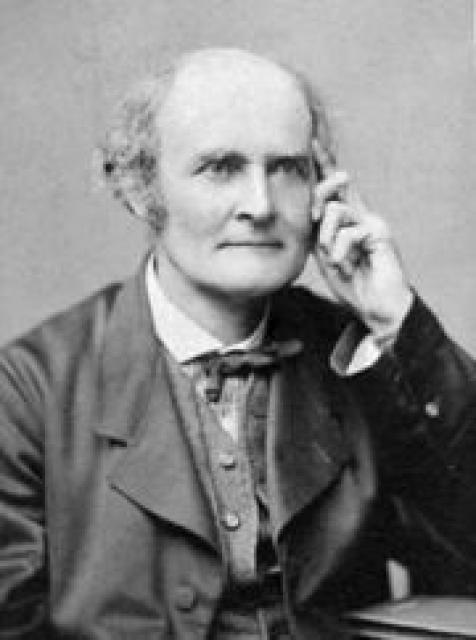
Arthur Cayley
 Great Britain
Biography of Arthur Cayley
Arthur Cayley was an English mathematician who was born in Richmond, London, England. He came from a family with a history of innovation and achievement. His father, Henry Cayley, was a distant relative of Sir George Cayley, a pioneer in aviation. His mother, Maria Antonia Doty, was the daughter of William Doty.
Early Life and Education
Cayley spent his first eight years in St. Petersburg, Russia, where his family had settled. In 1829, his parents moved to Blackheath, near London, and he attended a private school. Even as a child, Cayley showed a talent for solving complex mathematical problems for fun. At the age of 14, he entered the Royal School in London, where one of his teachers recognized his genius and advised his father to prepare him for admission to the University of Cambridge instead of teaching him the family business.
University and Career
At the remarkably young age of 17, Cayley entered Trinity College, Cambridge. During this time, the Analytical Society was flourishing, and Gregory and Leslie Ellis founded the Cambridge Mathematical Journal. At the age of 20, Cayley submitted three manuscripts to the journal, inspired by reading Lagrange's "Mécanique analytique" and some of Laplace's works.
Cayley completed his undergraduate education by winning the Senior Wrangler prize and the Smith's Prize. He then pursued a Master of Arts degree and received a scholarship. His mentor at Cambridge was George Peacock, and his personal coach was William Hopkins. Cayley continued to stay at Cambridge for four years, during which he took on several students and prepared 28 memoirs for the mathematical journal. As his scholarship was not permanent, he had to choose a profession. Like De Morgan, Cayley chose to become a lawyer and was admitted to Lincoln's Inn in London when he was 25 years old. He specialized in transportation law and attended a lecture by Hamilton on quaternions in Dublin while studying for his bar examination.
Mathematical Contributions
During this period of his life, which lasted about 14 years, Cayley published between 200 and 300 works. In around 1860, several funds left by Lady Sadler to the university, which had become useless for their intended purpose, were used to establish another professorship named the Sadlerian Professorship. Cayley was elected to this position when he was 42 years old. He gave up his lucrative practice for a modest salary but never regretted his decision.
As a professor, Cayley was able to fully devote himself to mathematics without dividing his loyalty between law and mathematics. Immediately after his appointment, he married and settled in Cambridge. His home was filled with happiness and became more successful than Hamilton's. Cayley and Sylvester, his friend and collaborator, would often walk around the Lincoln's Inn gardens, discussing theories of invariants and covariants.
Cayley was one of the most prolific scientists of the 19th century, having written over 700 works. In 1882, he was awarded the Copley Medal by the Royal Society of London for his contributions to mathematics. Most of his work focused on linear algebra, differential equations, and elliptic functions. He was able to prove the Cayley-Hamilton theorem, which states that every square matrix is a root of its characteristic polynomial.
Cayley also made significant contributions to the field of group theory, being the first to formulate the definition of a group as we know it today - a set with a binary operation that satisfies certain laws. Previously, when mathematicians spoke of a group, they referred to a group of permutations.