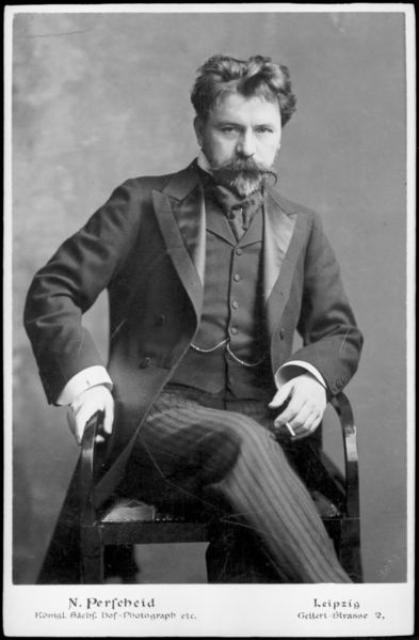
Artur Nikisch
 Germany
- Biography of Arthur Nikisch
- Career Beginnings
- International Success
- Artistic Style and Legacy
- Personal Life
Biography of Arthur Nikisch
Early Life and EducationArthur Nikisch was a Hungarian conductor and one of the pioneers of modern conducting. He was born into a family of a Moravian father and a Hungarian mother. Showing excellent musical abilities at an early age, he initially received private lessons and later studied violin with Joseph Hellmesberger and composition with Dessoff at the Vienna Conservatory. Nikisch also achieved great mastery in piano performance and received numerous awards for his own compositions, but his primary instrument became the violin.
Career Beginnings
In 1874, he became a member of the Vienna Court Orchestra, which was conducted by renowned musicians such as Johannes Brahms, Franz Liszt, Giuseppe Verdi, and Johann Herbeck. Nikisch participated in the premiere of Anton Bruckner's Second Symphony under the composer's direction and in 1876, he played in the orchestra at the opening of the first Bayreuth Festival, conducted by Richard Wagner himself. In 1878, Nikisch became the second conductor at the Leipzig Opera House, and a year later, he became its chief conductor. This marked the beginning of Nikisch's conducting career, which brought him worldwide fame.
International Success
In 1889, he became the music director of the Boston Symphony Orchestra and gave numerous concerts in the United States. Nikisch's innovative and free interpretations of well-known works, such as Beethoven's Fifth Symphony, caused a storm of conflicting reviews among critics and increased public interest in him. In 1893, he became the musical director of the Budapest Opera House, and two years later, he simultaneously received invitations to become the chief conductor of the Leipzig Gewandhaus Orchestra and the Berlin Philharmonic Orchestra. Nikisch accepted both invitations and later also led the Philharmonic Concerts in Hamburg, holding these positions until the end of his life. With the Berlin Philharmonic Orchestra, Nikisch toured almost all of Europe and performed in Moscow. As a guest conductor, he also worked with the Amsterdam Concertgebouw Orchestra and the Vienna Philharmonic Orchestra. From 1904 to 1914, Nikisch frequently conducted the London Philharmonic Orchestra, with which he embarked on a concert tour of America in 1912. While working at Covent Garden Theatre, Nikisch directed several productions, including Wagner's "Ring Cycle" in 1913. In addition to his conducting career, he served as the director of the Leipzig Opera (in 1905-1906) and the Leipzig Conservatory, where he also taught conducting.
Artistic Style and Legacy
Arthur Nikisch was acquainted with the musicians of the Belyayev Circle and attended the famous "Belyayev Fridays" in Saint Petersburg. He is one of the most famous and influential conductors of his time, renowned as an outstanding interpreter of romantic music, including the works of Schumann, Brahms, Bruckner, Tchaikovsky, Wagner, and Beethoven. It was after Nikisch's performance of Bruckner's Seventh Symphony that the composer's name gained wide recognition, and in 1888, Nikisch triumphantly performed Tchaikovsky's Fifth Symphony in Saint Petersburg, despite its initially cool reception by the public at its premiere under the composer's direction. Tchaikovsky, who had heard Nikisch a year before, wrote about him: "Mr. Nikisch is calm and free from unnecessary movements, cool-headed, and at the same time very strict. It seems that he is not conducting but performing some magical gestures. He does not try to attract attention to himself, but it is felt that the large orchestra, like an instrument in the hands of a skilled master, completely submits to its leader." According to contemporaries, Nikisch always demanded impeccable sound from the orchestra members and had a very flexible sense of tempo. His artistry influenced subsequent generations of conductors, including Wilhelm Furtwängler, who took over the Leipzig and Berlin orchestras after Nikisch's death, and Adrian Boult. Nikisch supported contemporary composers such as Gustav Mahler, Max Reger, and Richard Strauss, frequently performing their works in concerts. Nikisch's own compositions are not performed in modern times.
Personal Life
Nikisch was married to the singer Amélie Heussner, and their son Mitya (1899-1936) became a renowned pianist.