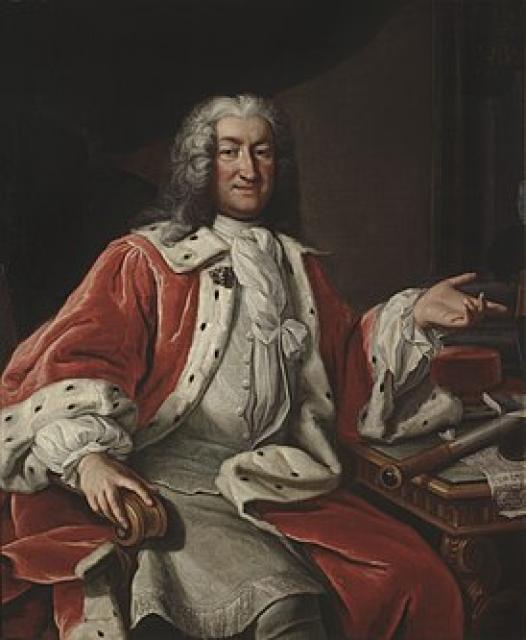
Arvid Horn
 Sweden
- Early Life and Military Career
- Northern Wars
- Political Rise
- Hannoverian Alliance and Later Career
- Retirement and Legacy
- Family
- Inga Thörnflycht (1705-1708) had no children.
Early Life and Military Career
Carl Gustaf Horn was born in Finland in 1664 to a military family. At the age of 18, he joined the Swedish Royal Guard. In 1687, he joined the Austrian army and later fought for the Dutch against the French from 1690 to 1695. Upon returning to Sweden, he rose through the ranks, becoming a captain in 1693 and a captain-lieutenant of the Guard in 1696.
Northern Wars
Horn played a significant role in the Great Northern War. In 1700, he participated in the invasion of Zealand. He also fought in the battles of Narva, Düna, and Kliszów, where he was wounded twice. In 1704, he was appointed General-Lieutenant and sent to Poland as the Swedish representative, where he supported the candidacy of Stanisław Leszczyński. Captured during the siege of Warsaw, Horn was exchanged and returned to Sweden in 1705.
Political Rise
Following the death of Charles XII, Horn played a key role in limiting the power of the monarchy and expanding the authority of the Riksdag. In 1719, he resigned as President of the Chancery College, but was reinstated in 1720 after the accession of Frederick I. He advocated for peace with Russia and economic recovery.
Hannoverian Alliance and Later Career
In 1724, Horn concluded a defensive alliance with Russia and pursued a mercantilist policy. In 1726, he supported Sweden's entry into the Hanoverian Alliance, which opposed Austria, Spain, and Russia. Twice elected Speaker of the Riksdag (1726-1727 and 1731), Horn maintained a pro-Russian foreign policy, but was defeated by the "Hats" faction in 1738-1739.
Retirement and Legacy
Horn was forced to resign in 1738 and retired to his estate, where he died in 1742. He was known for his pragmatism, diplomatic skills, and commitment to economic development. Horn's legacy includes the strengthening of the Swedish parliament and the establishment of alliances that promoted stability in Europe.
Family
Horn was married three times:Anna Beata Ehrensten (1696-1703) had three children, only one of whom survived to adulthood.
Inga Thörnflycht (1705-1708) had no children.
Margareta Gyllenstierna (1710-1740) had six children, three of whom survived to adulthood.