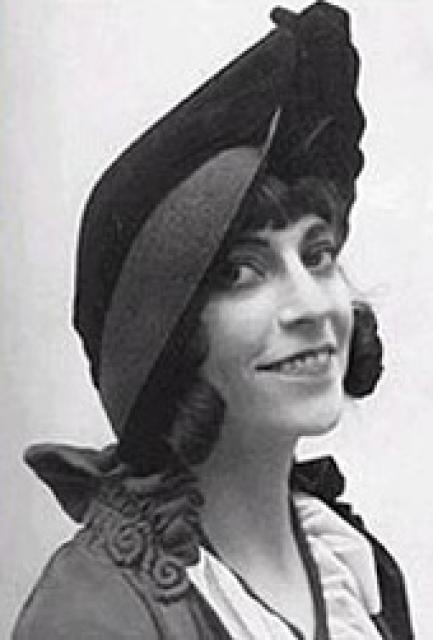
Asta Nilsen
 Germany
- Biography of Asta Nielsen
- A Face Unsuitable for the Movies
- Early Life and Career
- The Unique Acting Style
- Roles and Impact
- An Eventful Life
- Life with Director Urban Gad
- The Burden of Fame
- A New Love and Life in Russia
- A Harmonious Life
Biography of Asta Nielsen
The First Actress in the WorldAsta Nielsen was a Danish film actress who became the first actress in the world. She should not be confused with the first movie star, which is Florence Lawrence. To become a star, all it took was beauty and regular appearances on screen. But to become a great actress, as Asta Nielsen was called, one needed to possess a vibrant and undeniable dramatic talent. Asta Nielsen belonged to the era of silent film.
A Face Unsuitable for the Movies
The operator of her first film immediately after meeting Nielsen, said abruptly, "Your face is completely unsuitable for the movies!" and turned away indifferently. But the director, turning him by the shoulder, declared, "No, you will film her!" "Who is the professional here, you or me?" the operator got angry. He was indeed a professional, the best in Denmark at the time, and the director was a young boy embarking on his first film. But how short-sighted professionals can be! Nielsen's face, which could not be called beautiful, transformed remarkably on screen. Deep-set eyes, high arched thin eyebrows, tragic lines in the corners of her nervous mouth, a crown of jet-black hair - all of this powerfully attracted the gaze and left a lasting impression.
Early Life and Career
Asta Nielsen was born in Copenhagen in 1881. At the age of seventeen, in the first year of the new century, she made her debut on the theater stage. In 1910, she embarked on her career in cinematography. At that time, the film industry was just emerging from its infancy. Her first film was called "The Abyss," and the film crew rented a former prison in Copenhagen for the shooting location - the cheapest option, as they had to save every penny. They set up dressing rooms in empty cells and built sets in the prison yard. Throughout the day, they diligently rotated with the sun as there were no other lighting fixtures. The most astonishing thing was that the film, shot under such conditions, had a stunning success.
The Unique Acting Style
Asta Nielsen played in a way that had never been seen in silent films before. When she portrayed passion or suffering, she did not theatrically wring her hands, tilt her head, or wildly roll her eyes. The tragedy was evident in her eyes, the arch of her eyebrows, and the expressive and nervous contours of her figure. Nielsen economized on gestures, being precise and expressive in every movement. Renowned connoisseur of world cinema, Georges Sadoul, included Asta Nielsen in his shortlist of the best tragic actresses to ever appear on screen. In fact, he began his list with her. Critics of the time often compared later celebrities such as Greta Garbo and Marlene Dietrich to the brilliant and legendary Scandinavian actress.
Roles and Impact
Who did she play? In "The Abyss," she played Magda, a music teacher who left her faithful and kind fiancé for a handsome circus performer named Rudolf. She fell madly in love with him, and he professed his love to her while secretly seeing another woman. Then Magda, in the best traditions of the cinema of that time, ruthlessly stabbed him to death with a dagger. In "Joyless Street," Nielsen portrayed a glamorous courtesan, and in "The Suffragette," she became an emancipated lady. In the plot, she places a bomb under the desk of a detested minister, an oppressor of women, only to find out later that the minister is the same wonderful stranger she loves. The plot of the film could have been ridiculous, but its success exceeded all imagination when Asta Nielsen played in it. She did not play golden-haired and kind Cinderellas like Mary Pickford or delicate and melancholic victims of betrayal and deceit like Vera Holodnaya. Her domain was women struggling, deeply and passionately feeling, for whom love was always conflicting and tragic.
An Eventful Life
There was a funny story that happened during one of her roles. In the film "Little Angel," 28-year-old Nielsen played a mischievous girl whose father buys dolls for her, unaware that his daughter flirts shamelessly with every passing soldier. The film horrified the censorship board because, in one scene, the little angel climbed the stairs, and for a moment, her garter was visible under her knee-length skirt. It was a scandal! The scene was replayed over and over again. They debated for a long time whether it was simply an innocent bow or a scandalous garter holding up her stocking. But since the scene lasted only a second, they could not come to a clear conclusion. Then another scandal arose. Towards the end of the film, it was revealed that the little angel was actually 18 years old and only pretending to be a 14-year-old girl. This was because a wealthy uncle had arrived at their home, and they could not let him see that the child was much older, meaning she had been born before her parents' wedding. It was too much! The film was banned indefinitely. It was only through the uproar in the press that the ban was eventually lifted.
Life with Director Urban Gad
There was a person in Asta's life who did a lot for her career - a director with an unusual surname for Russian ears, Gad. When the "great silent" era came to an end, Nielsen wrote her memoirs. In them, she devoted many pages to Urban Gad. But she never mentioned anywhere that he became her first husband. Asta always sharply separated her work from her personal life and fiercely protected it from prying eyes. In those days, stars were still able to do that.
When they were filming "The Abyss" together, there was no romance between them. He worked as a set designer at the same theater in Copenhagen as her. By 1910, a crisis had emerged in the theater life of the capital, and half of the troupe was not involved in any performances, including both of them. One day, the young people coincidentally met on the street, chatted, and lamented their failures. "It's time to go and act in movies," Asta sighed. "Now I regret turning down the offer from the 'Union' company." "What if I write a screenplay, and you play the role in my film?" Urban suddenly asked. "It depends on the screenplay and the role," Asta evasively replied. And that was how they parted. At that time, nobody took cinema seriously, as an art form, and there was no talk of it. The noble audience condescendingly considered these "jumping pictures" as entertainment for servants. Serious actors felt ashamed to appear in movies. A few days passed. Asta had already forgotten about their recent encounter, but then Gad brought her the screenplay. That was "The Abyss." Immediately after the release of the film, which brought Nielsen worldwide fame, a major German film company offered her 40,000 marks per role in their films. Together with Gad, Asta moved to Berlin and became a German film star for many years. Eventually, they got married. They were one of the first examples of a successful union between a director-husband and an actress-wife cast in leading roles. For each of these roles, Nielsen soon began to be paid 400,000 marks.
The Burden of Fame
The unprecedented popularity made life very difficult. Nielsen called her fame an earthly hell for a person, without any coquetry. In Berlin, she dared not be seen on the streets or in stores. Even in the theater, she had to sit in a box with tightly drawn curtains and watch the performance through a crack. In her memoirs, Asta confessed that her life outside the film studio was spent either in a car or at home. Of course, she was exaggerating a bit. There were exclusive clubs, restaurants, and the homes of friends where she socialized with many people. Once, when she visited acquaintances, she saw a man with a noble face sitting in an armchair. She was introduced to him as "Russian writer Count Alexei Tolstoy." Another man sat in another chair, a handsome brunet with his sleeves rolled up in a shirt with an Apache collar. He played the guitar wonderfully and sang something she had never heard before. Later, she learned that he was a famous Russian romance singer. He was introduced as "Actor of the Moscow Art Theatre Grigory Khmara." It was the early post-revolutionary years, and Russian emigrants had flooded Berlin. At that time, Asta was nearing forty, while Khmara was thirty. He had a bright personality and a broad character, and he charmed everyone with his charisma. He charmed her too - Nielsen fell madly in love.
A New Love and Life in Russia
Later, she found out that the crocodile leather suitcase containing a change of delicate batiste underwear, a luxurious Spanish shawl, and a gypsy guitar with rare pearl inlays was all the belongings that Khmara brought with him to Berlin. He did not have time to become famous in Russian silent films; his life, like the fates of millions of other people, was turned upside down by the events of 1917.
They became partners in many films, including "Nastasya Filippovna" based on Fyodor Dostoevsky's novel. Again, Asta did not mention anywhere that he became her second husband. In her memoirs, she wrote about all the Russians she knew, but it was clear that she was primarily referring to Grigory: "The Russians I knew lived in a different, unfamiliar tempo. We loved and admired them, but their temperament often scared us with their whims. It was often difficult to understand them, difficult to take them seriously because of their Dostoevsky-esque and Tolstoyan nature. It seemed to us that they did not follow these teachings correctly. But they truly, sincerely knew how to forgive, their kindness and love for others reached boundless self-sacrifice, and they had an incredible love for art and the beautiful. As for me, I loved almost all of them."
A Harmonious Life
Simultaneously wild and gentle, meek and uncontrollable, unrestrained in emotions and desires, Grigory redirected Asta's measured life as a German film diva into a completely different channel. Asta experienced both the bright and dark sides of the Russian soul, and both were embodied in the handsome Muscovite with a velvety voice and blue eyes. But she had no regrets because it was with Grigory that she experienced in life the storm of emotions that she had previously only created on screen.
Nielsen belonged to the "great silent" era. She only appeared in one sound film and then left the cinema. But even in her new life, she managed to find herself. She created large-scale paintings from scraps of colored fabric. The paintings depicted people, animals, landscapes, and stunningly beautiful flowers. Exhibitions of her works were held in various cities in Europe. When a slim gray-haired lady appeared at the vernissage, elderly people would exclaim, "That is the real Asta Nielsen!"
She rarely held exhibitions. She loved solitude, her quiet home filled with flowers. In her later years, she wrote her memoirs and concluded them with remarkable words, "Life, after numerous wonderful events and storms, became harmonious. Those who can hear the music of silence will hear a symphony of unprecedented beauty."