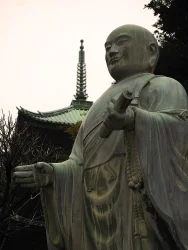
Atish Dipankar
- Early life and education
- A leading Indian Buddhist scholar
- Journey to Tibet
- Teaching and literary legacy
- Final years and legacy
Atish Dipankar, better known as Atisha, was a Bengali Buddhist scholar whose teachings helped shape the revival of Buddhism in Tibet during the eleventh century. A respected teacher at the Indian monastery of Vikramashila, he combined rigorous scholarship with a practical vision of the Buddhist path. His short guide to awakening became a model for generations of Tibetan teachers.
Early life and education
Atisha was born around 982 in Bengal, in a region then associated with the Pala Empire. Traditional biographies describe him as a prince named Chandragarbha who left royal life to pursue Buddhist learning. Details of his early years come largely from later religious accounts, which combine historical memory with stories about spiritual signs and past lives.
He studied at major Buddhist centers in northern India, including Nalanda and Vikramashila, and learned from a range of teachers. Traditional sources also recount a long journey to Sumatra, where he studied with the master Dharmakirtiśrī, known in Tibet as Serlingpa. There he deepened his understanding of bodhicitta, the aspiration to attain awakening for the benefit of all beings, which became central to his teaching.
A leading Indian Buddhist scholar
After returning from his travels, Atisha became a leading scholar and teacher at Vikramashila, one of the great monastic universities of the Pala period. He was learned in both philosophical traditions and tantric practice. His work brought together study, ethical discipline, meditation, and compassion, rather than treating them as separate or competing paths.
By the early eleventh century, Buddhist leaders in western Tibet were seeking teachers from India to help strengthen religious institutions and renew learning. Atisha was invited by the ruler Jangchub Ö, whose court hoped to establish reliable teaching and translation lineages. After years of requests, Atisha accepted the invitation and traveled across the Himalayas.
Journey to Tibet
Atisha arrived in western Tibet in 1042. He taught at Tholing and later traveled to central Tibet, working with local translators and students. His role was not simply to bring Indian texts across the mountains; he explained how different Buddhist teachings could fit into a coherent progression of practice and emphasized the importance of disciplined conduct.
At the request of Jangchub Ö, he composed the Bodhipathapradīpa, or “Lamp for the Path to Enlightenment.” In a concise series of verses, the text organized the path according to practitioners’ different capacities and motivations, bringing together foundational ethics, Mahayana compassion, and tantric practice. The work became a source for the Tibetan “stages of the path” tradition, known as lamrim.
Teaching and literary legacy
Atisha wrote and translated many works during his years in Tibet, covering both exoteric teachings and tantric topics. His emphasis on monastic discipline and careful interpretation became influential, though later accounts sometimes portray the religious situation he encountered as more uniform or chaotic than it likely was. Tibet already contained diverse Buddhist communities and lineages, and Atisha’s teachings entered that complex landscape through cooperation with local teachers and translators.
His close Tibetan disciple Dromtönpa carried forward his instruction and established the Kadam tradition after Atisha’s death. Kadam teachings later influenced other Tibetan Buddhist schools, including the Gelug tradition. Atisha’s approach to the gradual path also gave later writers a framework for presenting large bodies of Buddhist doctrine in an ordered, accessible form.
Final years and legacy
Atisha spent the final twelve years of his life in Tibet and died in 1054 at Nyethang, near Lhasa. He is revered in Tibet as one of the central figures in the later transmission of Buddhism. In Bengal and Bangladesh, he is remembered as a major scholar from the region whose influence reached across Asia.
His lasting achievement was both intellectual and institutional. Through his teaching, writing, and collaboration with Tibetan students, he helped connect Indian Buddhist scholarship with a new generation of communities in Tibet. The “Lamp for the Path” endured because it presented a broad religious tradition as a practical, step-by-step journey toward awakening.