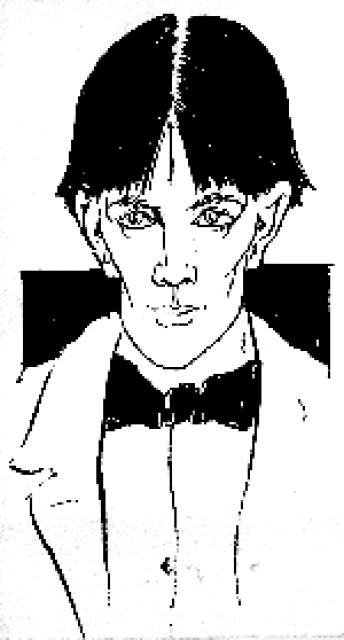
Aubrey Vincent Beardsley
 Great Britain
- Biography of Aubrey Vincent Beardsley
- Early Life and Artistic Development
- Artistic Style and Influence
- Legacy and Death
Biography of Aubrey Vincent Beardsley
Aubrey Vincent Beardsley was an English artist, musician, and poet. His phenomenon has no parallel in the history of European visual arts, although, cruelly ironic, the genius artist was only granted five years of active creative work. Beardsley, a brilliant English artist, musician, and poet, lived a short life, dying at the age of twenty-five, but his art remains unmatched and unique. The late 19th to early 20th centuries, like a "horn of plenty," bestowed upon the world a tremendous number of geniuses with non-traditional sexual orientations - Erik Satie, Oscar Wilde, Claude Debussy, Sergei Diaghilev, Pierre Louÿs, Jean-Arthur Rimbaud, etc. - who made invaluable contributions to the development of art. Beardsley can confidently be included in this group, as the "genius of miniatures," who had a significant influence on the entire art of the modern style. His phenomenon has no parallel in the history of European visual arts, even though, cruelly ironic, the brilliant artist was only granted five years of active creative work. It seemed that Beardsley had no chance of becoming a professional artist, as he did not attend art schools, did not paint any large-scale paintings, and did not have a solo exhibition during his lifetime. Most of his works were book illustrations or drawings. Nevertheless, Beardsley is an astonishing and enigmatic phenomenon of art and human spirit. His father was from a family of London jewelers, and his mother was from a respected family of doctors. Beardsley's father, Vincent Paul Beardsley, suffered from tuberculosis, an inherited disease that prevented him from having a permanent job. Aubrey himself realized the uniqueness of his situation at a very young age. When he was seven years old, he already knew that his father's illness had been passed on to him. In the 19th century, there was still no way to combat this dreadful disease, so Beardsley understood from an early age that he could die unpredictably early and quickly.
Early Life and Artistic Development
From childhood, Beardsley began writing poetry and learning to play the piano. He soon formed his "circle of talent admirers," which included the famous Oscar Wilde. Thanks to the friendly support of several aristocratic families, Beardsley diligently developed his exceptional artistic, poetic, and musical talents and soon started performing as a pianist, giving concerts. Moreover, many of his poetic compositions, despite his young age, already stood out for their uniqueness and embodied a subtle and profound knowledge of the works of his predecessors. Thanks to his mother, Beardsley had an excellent knowledge of English and French literature from a young age. All these brilliant talents, unfortunately, were not destined to fully develop due to the progressing disease, whose symptoms became apparent year after year. The constant sense of death standing relentlessly behind him compelled him to live as if each day could be his last. Although Beardsley always valued his reputation as a music lover, bibliophile, and brilliant connoisseur of the collections of the British Museum and National Gallery, drawing was the true passion that filled him with insane energy or threw him into the depths of melancholy and depression. Such mood swings were characteristic of many tuberculosis patients, and Beardsley understood that it shortened his already limited days.
Artistic Style and Influence
As an artist, Beardsley initially experienced the influence of William Morris and Edward Burne-Jones, the latter of whom he subjectively considered the "greatest artist of Europe." However, their graphic style was too weak and sluggish for the temperament of Beardsley. The study of Japanese prints, with their harmony of line and spot, became much more important. Deep immersion in the traditions of Japanese art allowed him to create a remarkable synthesis of the West and the East in his own drawings. In one of his letters, he reflected, "How little the importance of line is understood now! It is precisely this sense of line that distinguished the old masters from the modern ones. It seems that contemporary artists strive to achieve harmony in color alone." However, Beardsley's own posters prove that he was a gifted and original colorist, akin to Bonnard and Toulouse-Lautrec. Beardsley's masterful and virtuoso use of line, playing with the black and white spots of silhouettes, made him a globally renowned artist within a year or two.
As a brilliant dramatist, Beardsley "staged" the figures on the "scene" of his drawings, creating so-called mise-en-scènes in which important and crucial phrases had to be uttered. These drawings had no secondary elements - only what was essential and fundamental. His art impresses with the detail as a given, which he emphasized and made unforgettable, turning it into a symbol. In his art, Beardsley always remained true to himself and never conformed to the fashionable trends of the time. Rather, the movement of the English decadents and Art Nouveau was oriented towards his work, thus Beardsley influenced the formation of the visual language of the modern style.
From April 1894, Beardsley began collaborating with the magazine "The Yellow Book" and soon became its art editor. His drawings, essays, and poems started appearing in large quantities in the magazine. Under Beardsley's influence, the magazine acquired a homoerotic direction and gained quite a scandalous reputation. Old-fashioned England had never seen anything like it before. The public was stirred up, and everyone awaited an explosion, which soon occurred. In April 1895, Oscar Wilde was arrested and taken into custody on charges of homosexuality. Newspapers reported that when going to jail, Wilde took with him gloves, a cane, and "The Yellow Book." There was an unfortunate misunderstanding in the printing house: a reporter present during the arrest at the Cadogan Hotel wrote that it was "A Yellow Book," i.e., a "yellow-colored book," not the journal "The Yellow Book." Oscar Wilde, by the way, hid a copy of Pierre Louÿs' "Aphrodite" under his armpit. However, the outraged crowds marched towards the magazine's office, smashing all the windows and demanding the immediate closure of the journal. Beardsley had to bid farewell to "The Yellow Book" forever.
It should be noted that "The Yellow Book" was not the only magazine with a homoerotic orientation. "Harper's" and "Atlantic Monthly" also published similar stories, illustrations, articles, etc. However, Beardsley's talent as an artist and editor made the magazine an outstanding event in England's cultural life. Wilde himself, however, did not particularly like "The Yellow Book" and never wrote for it, although he had long been friends with Aubrey Beardsley. Beardsley, on the other hand, created beautiful illustrations for Wilde's "Salome," which largely contributed to the book's success.
In the end, Beardsley found himself without means of subsistence for some time. He worked as an art editor for the magazine "The Savoy," made a living from occasional earnings until his new acquaintance, Leonard Smithers, convinced Beardsley to illustrate Juvenal and Aristophanes. The venture was risky and intended only for private or underground publications. Many contemporary critics consider these drawings to be the best among all of Beardsley's works.
Legacy and Death
The creative nature of a genius is difficult to explain. Genius, abnormality, and homosexuality, from the perspective of ordinary consciousness, are almost identical. The "pathological" nature of many of Beardsley's drawings can be somewhat explained by the fact that he always stood on the edge of an abyss: on one side was the light of life, and on the other, the abyss of non-existence. Constantly balancing between these worlds, he keenly felt them. Beardsley seemed to live in his own time and beyond it. This contributed to his detached observation. Better than anyone else, he knew the answer to the question: "What can I do that no one else can?" He had no time for secondary topics or artistic trivialities. Like Zarathustra, he wrote with his own blood. "And he who writes with blood and parables wants not to be read but to be learned by heart."
Beardsley's drawings left his contemporaries in awe. They inspired fear and reverence. Many felt that their perception of art and the world as a whole was crumbling.
As a true genius, Beardsley lived the lives of his characters in his drawings - he identified himself with them, immersed himself in their psychology, characters, and manners. Only in this way could true masterpieces be created. However, the heightened interest in hermaphrodites, the eroticism of the drawings, and the absolute freedom of self-expression served as the basis for many speculations. Rumors accused Beardsley of homosexuality, of having an immoral relationship with his own sister, of engaging in perverse debauchery. There are enough examples in the history of art when genius was mistaken for pathology. Genius often attracts new, unexpected, and even forbidden themes. In a short time, Beardsley managed to create a new, previously unknown world, and this world of remarkable images exists independently of the creator.
Shortly before his death, confined to his bed, Beardsley wrote a letter to Leonard Smithers, asking him to destroy all "indecent drawings" and the engraving plates for them. Aubrey Beardsley died in Menton, France, by the shores of the Mediterranean Sea in 1898, at the age of twenty-five.


