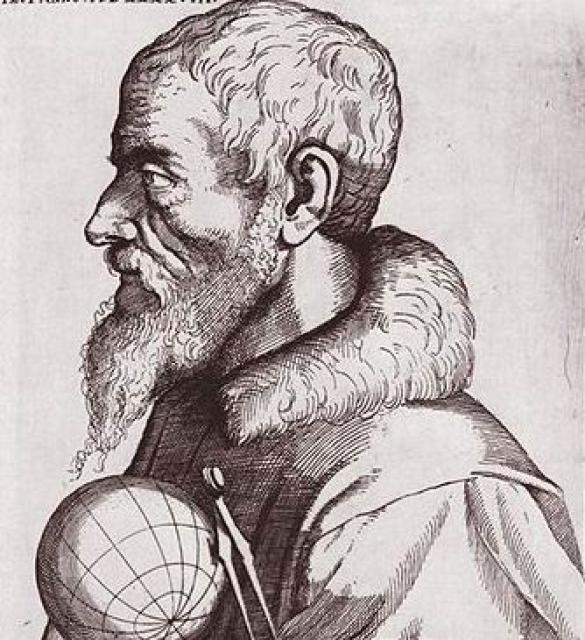
Augustin Hirschvogel
 Austria
- Background and Family
- Adapting to Changing Times
- Career as a Surveyor and Cartographer
- Geometric Innovations
- Artistic Endeavors
Background and Family
Augustin Hirschvogel was born into a family of artisans in Nuremberg, Germany. His father, Veit Hirschvogel (1461-1525), was a renowned master of stained glass, holding a virtual monopoly in the city. Augustin and his brother Veit Hirshvogel the Younger received training in their father's workshop.
Adapting to Changing Times
With the spread of the Reformation in Nuremberg, the production of stained glass for the Catholic Church became unprofitable. Seeking new avenues, Augustin Hirschvogel turned to other forms of artistry and craft. By 1530, he had established a workshop with Nuremberg potters producing painted and glazed earthenware jugs. These jugs became known as "Hirschvogel jugs," even when made by other workshops.
Career as a Surveyor and Cartographer
Around 1536, Hirschvogel pursued a career in surveying. In 1544, he settled in Vienna and embarked on extensive cartographic journeys for the Imperial Court, particularly Emperor Ferdinand I. He created maps of much of southern Europe, including the first contour and topographic maps of the city of Vienna.
Geometric Innovations
While it was once believed that Hirschvogel developed triangulation as a land surveying method and invented specialized surveying instruments, these assumptions have been recently debunked. Nonetheless, he made significant contributions to geometry, authoring a geometry textbook in 1543.
Artistic Endeavors
Alongside his surveying work, Hirschvogel was also an accomplished artist. He produced numerous engravings and prints, including landscapes and portraits, such as one of Paracelsus. His landscapes were influenced by the Danube School. He also illustrated the biblical typology "Concordantz Alt und News Testaments" (1550).


